During breeding season, both male and female sea turtles migrate from their primary feeding grounds to the waters near nesting beaches to mate. Sexual maturity in sea turtles depends on species type as well as carapace size for some. For Leatherbacks, sexual maturity can be as early as 7 to 13 years while in Green Sea Turtles, maturity can be as late as 26 to 40 years due to their herbivorous diet. Hawksbills have shown to reach maturity at a carapace length of 69 to 78 centimetres while Loggerheads reach maturity at a length of 50 to 87 centimetres. Leatherbacks reach maturity at 145 to 160 centimetres. Studies have found that some species of turtles continue to grow after reaching sexual maturity while others stop.
Courtship and Mating
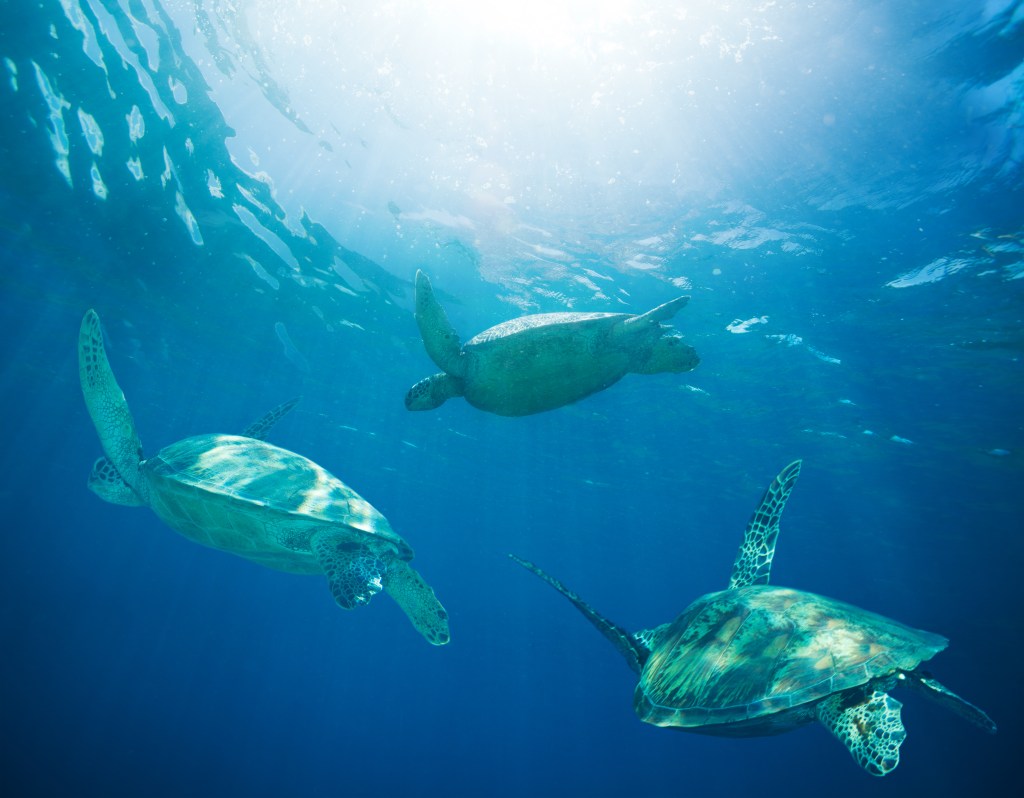
For most species, courtship and mating usually occurs several weeks before nesting during what is known as a limited receptive period, and females may be courted by two or more males. Eggs are fertilised by a variety of males which helps maintain genetic diversity within the population. Males have occasionally been observed to compete and even fight for females, though aggressive behaviour has also been observed in females. Males may court a female by nuzzling her head or by gently biting the back of her neck and rear flippers. If the female does not resist, the male attaches himself to the back of the female’s shell. Males have enlarged claws on their front flippers that aid them in grasping onto the shells of the females during mating. Males then fold their long tail under the female’s shell to copulate. Copulation takes place just offshore near nesting beaches either at the water surface or underwater and fertilisation is internal. It is possible that through the storage of sperm from one or several males in the oviducts of the females, all clutches of the current nesting season may be fertilised without repeated mating. Nesting females have been reported to have scratch marks on their shells and even bleeding from areas where males attached themselves to the shells.
Nesting
While sea turtles usually return to the same beaches where they were born, scientists studying Loggerheads have discovered that turtles that nest on beaches with similar magnetic fields are genetically similar to one another. This means that sea turtles migrate back to their natal beach or beaches with similar magnetic fields to that of their natal beach, even if that beach is geographically distant or with different environmental traits from the beach they were born. To understand more about how sea turtles migrate to nesting beaches using geomagnetic fields, see Migration: Orientation & Navigation.
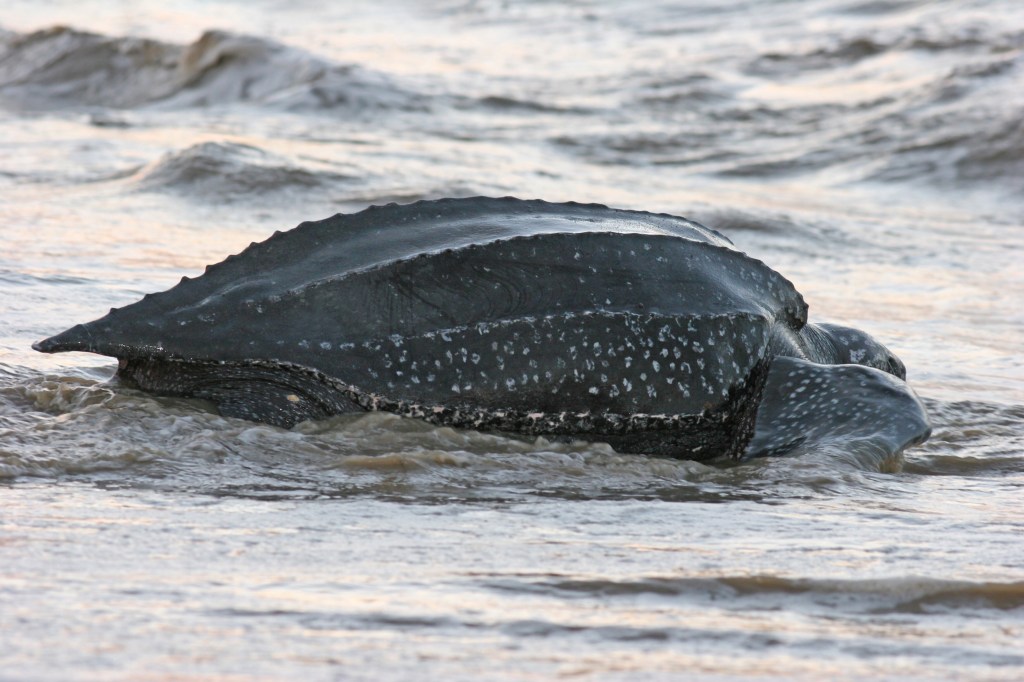
Females tend to come ashore to nest at night during high tide when they and their eggs are less vulnerable to predators. As she crawls out of the ocean, she will pause periodically to scope out her nesting spot. Occassionally she may crawl ashore and then crawl back into the ocean, possibly due to the presence of threats such as people, artificial lighting and animal predators. This is known as a false crawl. Depending on the species, sea turtles nest several times per breeding season and the interval between breeding seasons can also vary from one to three years. With exception to the Olive and Kemp’s Ridleys, sea turtles nest alone. Olive and Kemp’s Ridleys nest in large masses called arribadas (Spanish for ‘arrival’) which can include thousands of nesting females and, along with Flatbacks, can nest during the day due to their lighter colouration and smaller size.
Once the female has found a dry part of the beach to nest, she starts constructing a body pit to fit her body by flinging away sand with her front flippers and rotating her body. Once this is complete, she begins digging an egg cavity using her rear flippers. The depth of the cavity is determined by the length of the stretched hind flipper and can be up to one metre deep, shaped like a tear drop and slightly tilted. Once the egg cavity is complete, she lays her eggs. Two or three ping-pong-shaped eggs come out at a time covered in a layer of thick, clear mucus to ease the egg-laying process and for added protection. The number of eggs laid depends on the species but can range between 80 and 120 eggs. The eggs are soft, papery in texture and flexible, and therefore do not break when they drop into the egg chamber. This also allows the turtle and the nest to hold more eggs. As she lays her eggs, she secretes tears which cleanses the accumulation of salts in her eyes and body. It is believed that the turtle goes into a trance as she is laying eggs so as to not be disturbed, however, it is possible for her to leave this trance and abandon nesting if she feels endanger. Thus, it is important that sea turtles are never disturbed during nesting. Once all the eggs have been laid, the turtle uses her rear flippers to bury the eggs and pack the sand down to keep them moist, at optimum temperature and safe from predators before using her front flippers to bury the body pit and disguise the nest by throwing sand in all directions. This entire egg laying process is very exhausting for the turtle and can last more than two hours. Once the nest has been thoroughly concealed, she crawls back into the ocean to rest before either nesting again that season or migrating back to her feeding grounds. Once a female has left her nest, she never returns to tend to it. Experts can identify the species of turtle by the type of mound left by the nesting female and by her flipper tracks in the sand.
Incubation
The incubation period of the eggs depends on a combination of the turtle species and the temperature and humidity of the nest. Essentially, the warmer the surrounding sand, the faster the embryos will develop.
The temperature inside the nest determines the sex of the hatchlings. A temperature of approximately 29.5°C produces a mix of male and female hatchlings, while higher temperatures produce females and cooler temperatures produce males.
Hatchlings
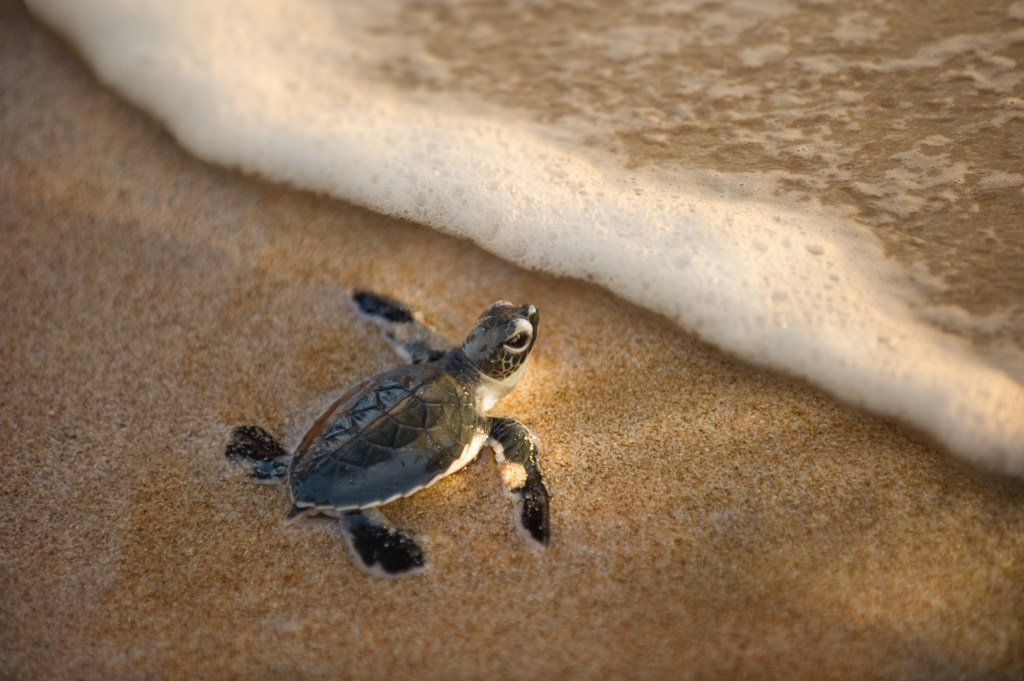
Sea turtles hatch throughout the year, but mostly in summer with the exception to Leatherback turtles which hatch in autumn and winter. Hatchlings are able to break open their shell using a sharp, temporary egg-tooth called a carbuncle which falls off shortly after birth. After hatching, the young turtles can take three to seven days to dig their way to the surface in a group effort. Hatchlings usually emerge from the nest at night or during rainfall when temperatures are cooler and it is safer from predators. Some nests have observed hatchlings emerging across multiple nights. Studies have shown that in undisturbed nests, more than 90% of eggs can hatch successfully while in nests disturbed by humans or animal predators, only 25% or less of eggs hatch.
As soon as hatchlings leave their eggs, they rapidly make their way towards the ocean guided by the low bright lights of the moon and night sky reflecting off the water, as well as the gentle downward slope of the beach and the auditory cue from the waves breaking. Within the first two or three days after emergence, nourished by their yolk sacs and thus do not feed, hatchlings start their migration on a swimming frenzy into deeper waters where they are less vulnerable to predators. Scientists believe that hatchlings spend the first few years of their lives in the pelagic deeper waters riding prevailing surface currents, situating themselves within floating seaweed where they can find food and stay protected from coastal predators. These early years are known as the ‘lost’ years where hatchlings and juveniles are rarely seen but face numerous obstacles including predators such as birds, sharks and large fish, as well as human obstacles such as chemical spills and the consumption and/or suffocation of plastic and tar balls. Because of these numerous obstacles, only about one in 1,000 hatchlings survives to adulthood. For more information on the journey hatchlings make towards the ocean and their journey offshore, see Migration: Orientation & Navigation.
References
Sea Turtle Conservancy: General Behaviour
Windle, A. E., Hooley, D. S. & Johnston, D. W. Robotic Vehicles Enable High-Resolution Light Pollution Sampling of Sea Turtle Nesting Beaches. Frontiers in Marine Science 6(493), 1-11 (2018).
Ye, M., Chen, H., Li, M., Duan, J. & Li, P. Observations on the Courtship and Mating Behavior of Captive Green Turtles (Chelonia mydas). Herpetological Conservation and Biology 15(2), 284-292 (2020).
 Koru Honu