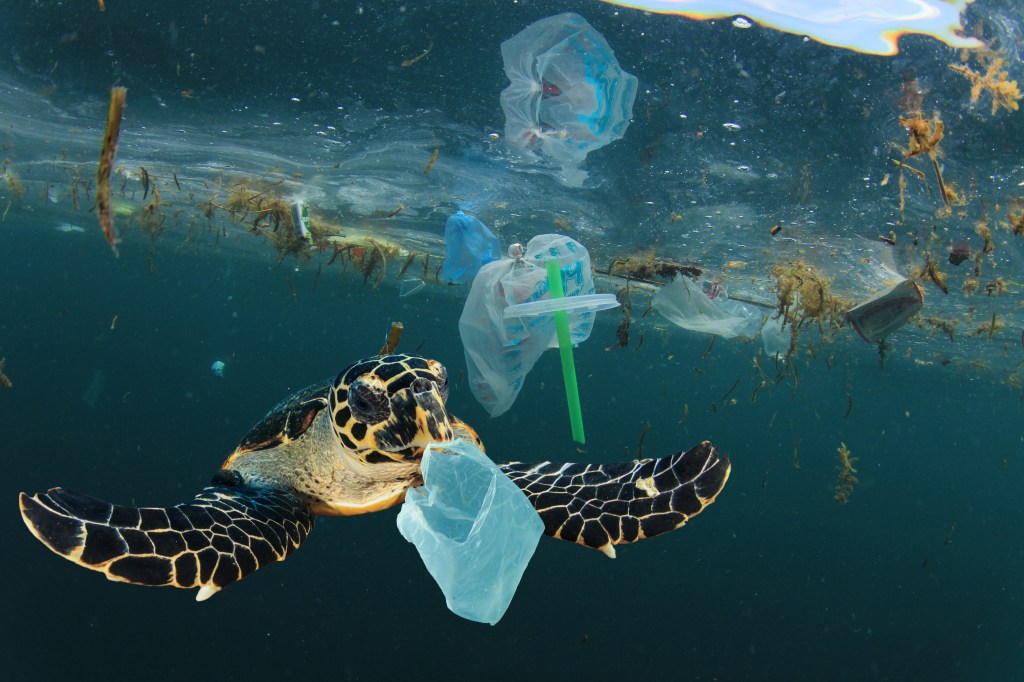
Every year, over a million animals, including turtles, mammals, fish, sharks and birds, are killed by plastic debris in the ocean, and it is estimated that there is currently over 100 million tons and more than 15 trillion pieces of plastic in the ocean since it started becoming mass produced in the 1940s. This outweighs the amount of plankton in the seas. Approximately 8 million tons of plastic enter the world’s oceans every year. That’s about a truckload every minute! Eighty percent of the ocean’s plastic originates from land; washed out to sea from beaches and streets, blown out of landfills, and flows out from storm drains into streams and rivers. Most of this waste originates from within 50 kilometres of a coastline, but some have also been identified to come from even farther inland. The other 20% is estimated to come from vessels and other marine sources. Most of the plastic comes from common items such as plastic bags, bottles, balloons, cigarette butts, lighters, degraded buoys, styrofoam, packaging materials, food wrappers and increasingly pre-production plastic pellets, also known as nurdles and often mistaken by birds for fish eggs. A stunning 90% of all plastic items are used once and discarded. Only 9% of all plastic by mass gets recycled (only 14% is collected to begin with). Eventually, an estimated 11% of all plastic waste ends up in aquatic ecosystems. The waste that ends up in the oceans tends to accumulate in gyres (areas of slow spiraling water and low winds) and along coastlines, thus leaving patches of plastic waste across the oceans including the Great Pacific Garbage Patch in the North Pacific Gyre where many hatchlings spend their early years.
While all sorts of debris enter the ocean, plastics make up the majority of marine debris for two reasons. First, plastic’s durability, low cost, and malleability mean that it’s being used in more and more consumer and industrial products. Second, plastic goods do not biodegrade but instead, break down into smaller pieces through photodegradation (the break down of material by light).
In a recent study, researchers from the UK, US and Australia studied 102 sea turtles from all eight species from the Atlantic and Pacific Oceans and the Mediterranean Sea. Their findings showed that every single one had ingested plastic, though the species that had ingested the most was the Green Sea Turtle from the Pacific Ocean with the ingested plastics accounting for almost 1% of their entire body mass. Research has suggested that over half of the world’s sea turtles have eaten plastic waste. Younger turtles, unlike their older counterparts, are less picky eaters and will eat anything making them even more at risk. These substantial pieces of plastic pose a deadly risk to animals who ingest them and it is estimated that 22% of sea turtles that ingest just one plastic item die. This is due to sharp plastics that rupture internal organs and bags that cause intestinal blockages leaving turtles unable to feed and giving them the sensation of feeling full, resulting in starvation. Plastic in their guts may damage a turtle’s ability to absorb food and nutrients, weakening them over time. Plastic bags and mylar balloons are often mistaken by sea turtles for being jellyfish while fishing nets are often mistaken for seaweed, both a large part of their diets. This is especially hazardous for sea turtles due to the structure of their bodies with their downward facing spine in their throats which prevents the possibility of regurgitation. The plastics get trapped in their stomachs which not only prevents turtles from feeding due to intestinal blockages, but also causes them to float as a result of trapped gas caused by harmful decomposition of marine debris inside a turtle’s body. These turtles are known as bubble butts and are often observed in rehabilitation centres. In the wild, floating turtles are prevented from feeding thus leading them to starvation, and turtles that float at the surface are also an easy target for predators and face vessel collisions. Unnaturally buoyant turtles are prevented from breeding and are also stunted in their growth which can lead to slow reproduction rates.
Not only do plastics pose a dangerous hazards for sea turtles internally, they also pose an external deadly threat as turtles can get entangled in plastic items such as six-pack rings or discarded fishing gear. This can lead to turtles dying from strangulation, drowning as they become trapped and unable to swim up to the surface to breathe, predation, losing limbs and generally injuring themselves, sometimes beyond repair. For more information on the threats of entanglement, see Entanglements & Incidental Capture.
In areas where patches of plastic debris accumulate on or near the surface of the ocean, sunlight may be blocked from reaching plankton and algae below. Algae and plankton are the most common autotrophs (organisms that can produce their own nutrients from carbon and sunlight, also known as producers) in marine ecosystems. If algae and plankton communities are threatened, sea turtles and other marine creatures could struggle to feed and possibly face starvation.
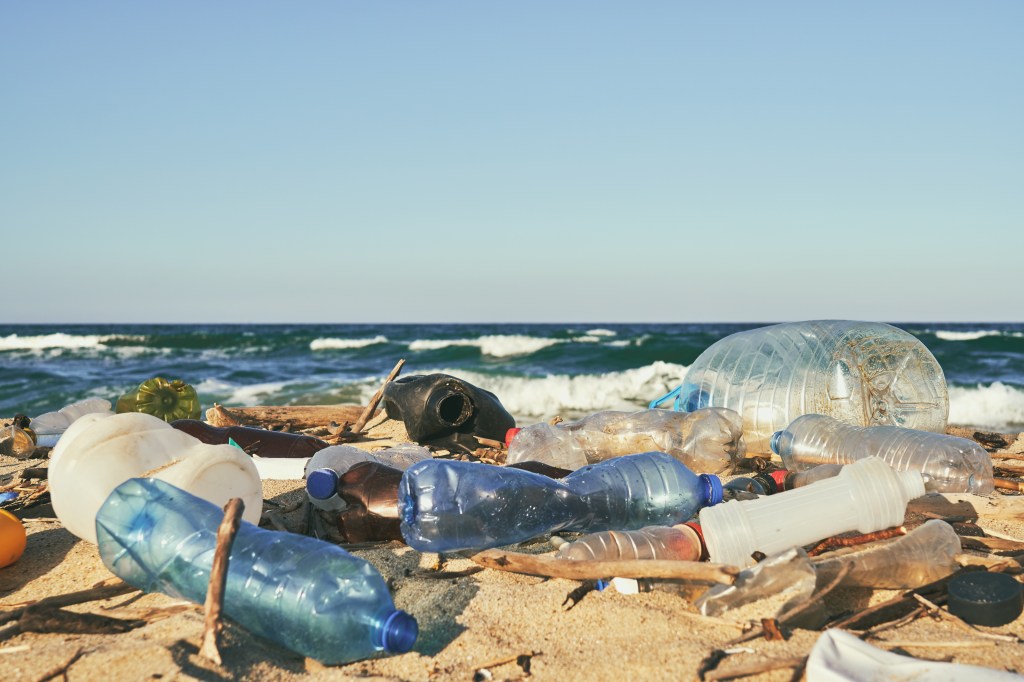
The accumulation of plastic on nesting beaches is also a major problem as hatchlings risk becoming entangled as they make their way to the sea, thus preventing them from reaching the water, making them a potential target for predators. Nesting females can also get entangled as they come ashore to nest. Furthermore, sometimes there is so much plastic on nesting beaches that the female turtles aren’t able to dig through the waste and they simply give up on laying their eggs. Since the survival rate of hatchlings is so low, it is crucial that sea turtles are able to successfully lay their eggs.
Furthermore, plastics contain toxic chemicals that are leached out into the water and enter the food chain, compromising the health of wildlife, their environment and ecosystems. Plastics floating on or near the ocean surface exposed to sunlight in a process known as photodegradation release methane and ethylene, two potent greenhouse gases that contribute to global warming. Plastics also absorb pollutants, such as PCBs, from seawater which can then enter the food chain when consumed by marine life.
Over time, plastics break down into microplastics (5 millimetres or less in size), and also enter into the ocean from clothing and cosmetics, which become even more toxic as they are more easily ingested and act as hosts for invasive species by carrying them to other regions of the oceans thus endangering existing and thriving ecosystems. As these pieces of plastics are so small, they make the ocean clean-up of plastic debris ever more difficult. Microplastics have turned the oceans into what scientists are calling a ‘plastic soup’.
Finally, plastics derive from fossil fuels. Drilling for fossil fuels has its own impacts on sea turtles including Climate Change, Noise Pollution and the risk of Oil Spills.
Summary
- It is estimated that there is currently over 100 million tons and more than 15 trillion pieces of plastic in the ocean since it started becoming mass produced in the 1940s.
- Approximately 8 million tons of plastic enter the world’s oceans every year.
- 80% of the ocean’s plastic originates from land; washed out to sea from beaches and streets, blown out of landfills, and flows out from storm drains into streams and rivers.
- The other 20% comes from vessels and other marine sources.
- An estimated 11% of all plastic waste ends up in aquatic ecosystems.
- Most of the plastic comes from common items such as plastic bags, bottles, balloons, cigarette butts, lighters, degraded buoys, styrofoam, packaging materials, food wrappers and pre-production plastic pellets.
- Plastics make up the majority of marine debris as they are used in many consumer and industrial products due to their durability, low cost and malleability, and they do not biodegrade, but rather photodegrade.
- Over half the world’s sea turtles have ingested plastic, and it is estimated that 22% of sea turtles that have ingested just one plastic item dies.
- Sharp plastics can rupture internal organs while bags can cause intestinal blockages damaging a turtle’s ability to absorb food and nutrients, leaving turtles unable to feed, and giving them the sensation of feeling full, resulting in starvation.
- Plastic bags and mylar balloons are often mistaken by sea turtles for being jellyfish while fishing nets are often mistaken for seaweed, both a large part of their diets.
- The downward facing spine of the throats of sea turtles prevents the possibility of regurgitation, including the regurgitation of plastic.
- Intestinal blockages from plastic causes turtles to float as a result of trapped gas caused by harmful decomposition of marine debris inside a turtle’s body. These turtles are known as bubble butts and are prevented from feeding and breeding, and are easy targets for predators and are at a higher risk of vessel collisions.
- Sea turtles are also at risk of getting entangled in plastic items (see Entanglements and Incidental Capture).
- Patches of plastic debris block sunlight from reaching autotrophs (such as plankton and algae) which could threatened the food supply for sea turtles and other marine creatures.
- Plastic on nesting beaches pose as obstacles to hatchlings making their way to the water putting them at risk of predation, as well as females coming ashore to nest who may get entangled in the debris or are unable to dig through the plastic and give up on laying their eggs.
- Plastics contain toxic chemicals that are leached out into the water, compromising the health of wildlife and their ecosystems.
- Plastics exposed to sunlight release methane and ethylene, two greenhouse gases that contribute to global warming.
- Plastics also absorb pollutants, such as PCBs, which can enter and threaten wildlife and ecosystems.
- Photodegration has caused the breakdown of larger pieces of plastic to become microplastics (<5mm) which are more easily ingested and act as hosts for invasive species. They also make the ocean clean-up of plastic debris ever more difficult.
- Plastics derive from fossil fuels which have their own impacts on sea turtles including Climate Change, Noise Pollution and Oil Spills.
The Great Pacific Garbage Patch
The Great Pacific Garbage Patch (GPGP) is the biggest accumulation of marine debris located in the North Pacific Ocean, spanning waters from Japan to the western coast of North America. This oceanic garbage patch was discovered by Captain Charles Moore in1997 and is approximately 1.6 million square kilometres, or twice the size of Texas, with debris extending six metres down into the water column. It is estimated that this ‘plastic island’ contains 79 thousand tonnes of trash and is increasing exponentially and at a faster rate than in surrounding waters.
The GPGP is bounded by the North Pacific Subtropical Gyre (Figure 1), a system of four currents rotating clockwise around an area of 20 million square kilometres: the California Current, the North Equatorial Current, the Kuroshio Current, and the North Pacific Current. The circular motion of the gyre creates a vortex where it draws marine debris such as plastic and other human-sourced non-biodegradable rubbish into the calm and stable centre where it becomes trapped.

The GPGP comprises of two major garbage patches: the Western Garbage Patch near Japan, and the Eastern Garbage Patch, located between Hawaii and California. These two areas are connected by the North Pacific Subtropical Convergence Zone where warm water from the South Pacific meets cooler water from the Arctic. This is where marine debris transfers from one zone to another. These patches are intermixed with larger waste items (mega-, macro- and mesoplastics), such as fishing gear and common household items, as well as broken down micro- and nanoplastics. A 2018 study found that synthetic fishing nets made up nearly half the mass of the GPGP, due largely to increased fishing activity in the Pacific Ocean. However, while micro- and nanoplastics account for 8% of the total mass, they make up 94% of the estimated 1.8 trillion plastic pieces of the GPGP.
The garbage patch doesn’t just exist on the surface. Oceanographers and ecologists recently discovered that about 70% of marine debris actually sinks either beneath the surface in the water column or to the bottom of the ocean.
Because the GPGP is so far from any country’s coastline, and the shear size of it proves costly, no nation will take responsibility or provide the funding to clean it up. Many individuals and international organisations, however, are dedicated to cleaning up the GPGP and preventing the patch from growing. Charles Moore, who discovered the patch in 1997, continues to raise awareness through his own environmental organisation, Algalita Marine Research Foundation. While the GPGP is the largest accumulation of marine debris, many other garbage patches exist in other oceans including the gyres of the South Pacific, North and South Atlantic and Indian Oceans, as well as smaller patches of marine debris in seas, rivers and estuaries around the world.
Solution
Plastic originates from fossil fuels. Therefore the first and foremost solution to plastic pollution is prevention, thus the cessation of offshore drilling and extraction of fossil fuels, which would lead to the cessation of single and multi-use plastics. We have managed without plastics in the past. Creatures of the natural world can live without plastics no problem. Nature maintains balance without plastic. Therefore, there is no reason why we will struggle to live without plastic. All existing uses of plastics have substitutes. By creating more jobs in these material sectors, the economy can swiftly move to normalising the use of non-plastic materials. We must remember that our happiness does not come from materials, but rather happiness is derived from meaningful experiences, appreciating the small things in life, surrounding ourselves with those we love, immersing ourselves with nature, as well as simplicity and humbleness.
Recycling has its limits. All plastics have an end of life after a number of recycles, and not everything ends up getting recycled. Often plastics go astray and end up littered in nature, both terrestrial and marine, consequently being mistaken for food by animals. It’s still important, however, that existing plastics be reused and recycled as far as possible, and ensure any plastic items put in recycling bins are secured to prevent them from flying away and going astray. Essentially, ensure all rubbish goes into bins and do not litter.
Don’t release balloons into the air. They travel far and end up in the oceans being consumed by sea turtles that mistake them for jellyfish. Ultimately, a ban on balloons should also be implemented as these are single-use and eventually end up in the waste.
Where there is demand, there is supply. Ways the public can get involved in ceasing the demand of plastics is by bringing their own fabric shopping bag, non-plastic food containers and tumblers, and avoiding products with plastic packaging where possible.
The increase in renewable energy also leads to the creation of jobs in energy conservation and renewables which will help swiftly shift the economy to more circular and cleaner, and away from fossil fuels and plastics.
While the cessation of plastics is an important step to ending plastic pollution, there is still a lot of marine and terrestrial plastic litter that needs cleaning up. This requires the attention of everyone including governments, organisations and the public. The public can help by joining beach clean-up organisations or by arranging their own.
Education about the impacts our reliance on fossil fuels and offshore drilling as well as plastics have on sea turtles, other marine wildlife and their ecosystems, and why marine ecosystems are important, is vital to ensuring people reduce and change their consumption habits and consciously buy products that are not plastic and without plastic packaging as far as possible.
Summary
- Cessation of offshore drilling and extraction of fossil fuels must be imminent, which would lead to the cessation of single and multi-use plastics.
- Existing plastics should be reused and recycled as far as possible, and ensure any plastic items put in recycling bins are secured to prevent them from flying away and going astray.
- Don’t release balloons into the air, and ultimately they should be banned.
- Bring your own fabric shopping bag, non-plastic food containers and tumblers, and avoid buying products with plastic packaging where possible.
- An increase in renewable energy leads to the creation of jobs in energy conservation and renewables which will help swiftly shift the economy away from fossil fuels and plastics.
- A major clean-up of plastic litter is essential.
- Educate the public about the impacts our reliance on fossil fuels and offshore drilling as well as plastics have on sea turtles, other marine wildlife and their ecosystems, and why marine ecosystems are important.
References
Algalita Marine Research Foundation
Bee’s Wrap: How Plastics Affect Sea Turtles
Duncan E. M., Broderick, A. C., Critchell, K. et al. Plastic Pollution and Small Juvenile Marine Turtles: A Potential Evolutionary Trap. Frontiers in Marine Science 8(699521), 1-12 (2021).
Jambeck, J. R., Geyer, R., Wilcox, C. et al. Plastic Waste Inputs from Land into the Ocean. Science 347(6223), 768-771 (2015).
Lebreton, L., Slat, B., Ferrari, F. et al. Evidence that the Great Pacific Garbage Patch is Rapidly Accumulating Plastic. Nature Scientific Reports 8(4666) (2018).
National Geographic: Great Pacific Garbage Patch
National Geographic: Ocean Trash: 5.25 Trillion Pieces and Counting, but Big Questions Remain
NOAA: Marine Debris Program
Ocean Conservancy: The Problem with Plastics
ProjectsAbroad: How can we help save sea turtles from plastic pollution?
Sea Turtle Conservancy: Threats from Marine Debris
See Turtles: Ocean Plastic & Sea Turtles
Safarik, S. What are the Impacts of Plastic Pollution on Sea Turtles and How Can We Prevent Them? Environmental Studies Undergraduate Student Theses 269 (2020).
The Ocean Cleanup: The Great Pacific Garbage Patch
Treehugger: The Great Pacific Garbage Patch
World Wildlife Fund: What do sea turtles eat? Unfortunately, plastic bags.
Image Source: Figure 1. The Great Pacific Garbage Patch is bounded by the North Pacific Subtropical Gyre and comprises of the Western and Eastern Garbage Patches – NOAA, 2022
 Koru Honu