Common Name
Olive Ridley Sea Turtle
Scientific Name
Lepidochelys olivacea
Description
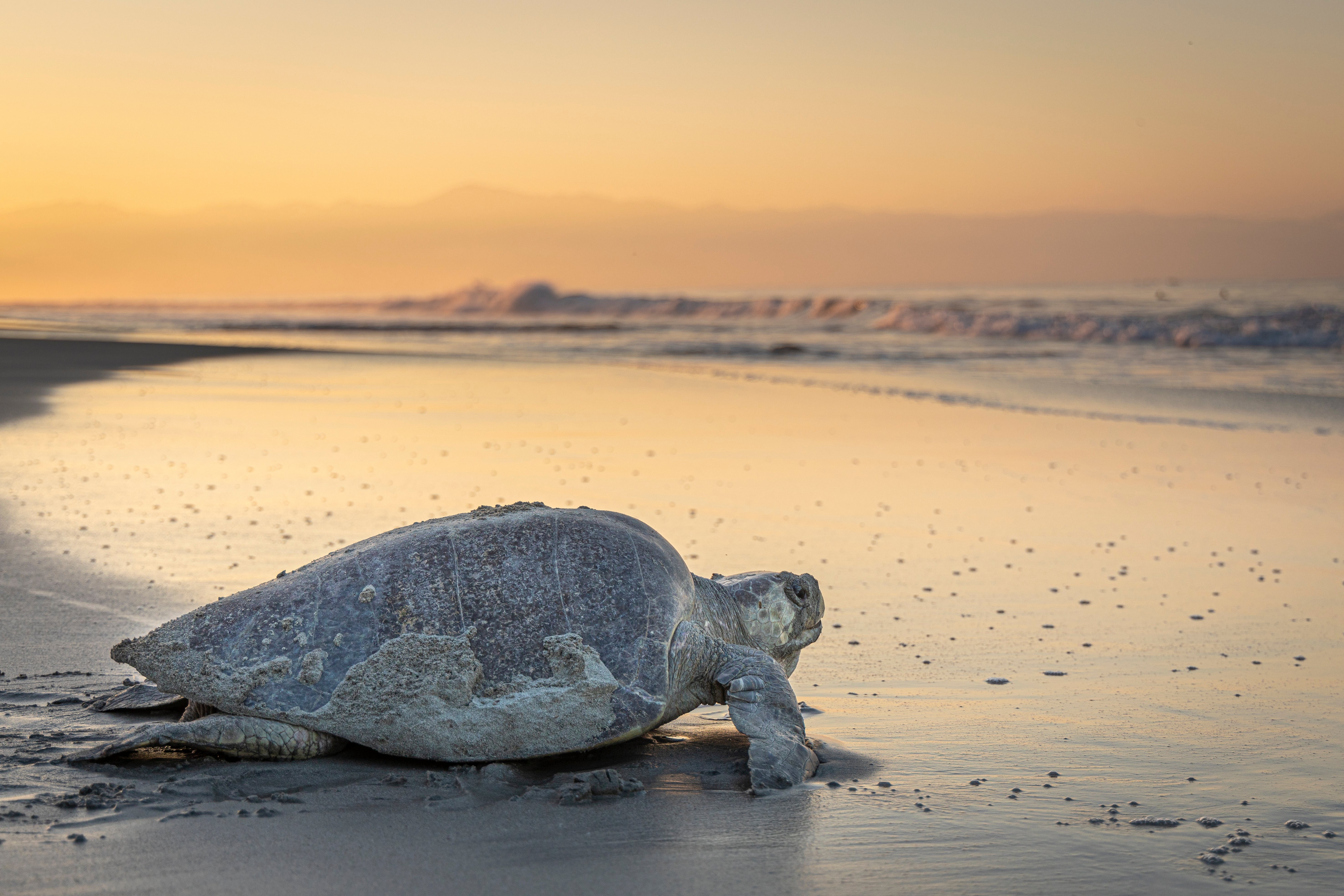
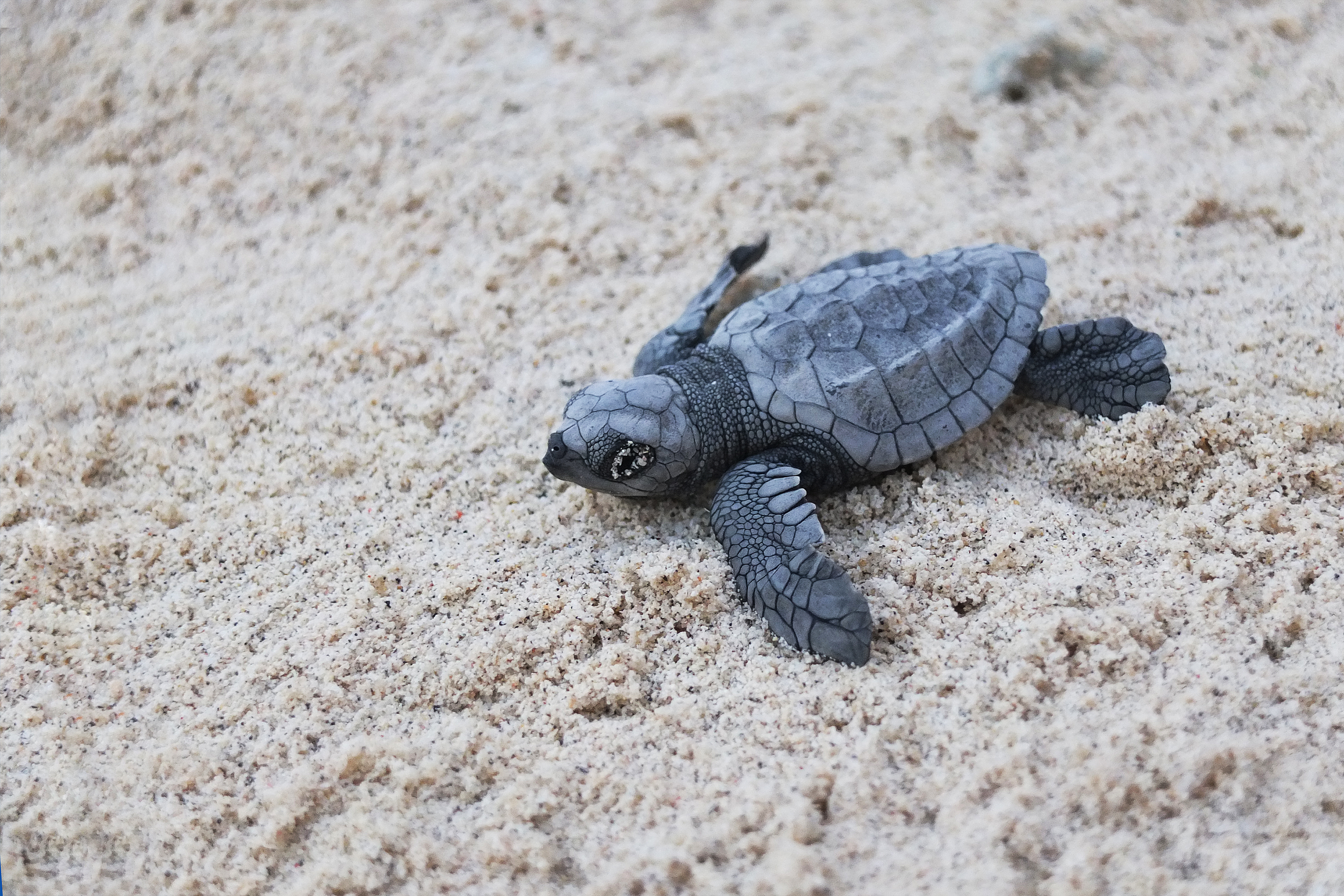
Named after Henry Nicholas Ridley, a botanist who encountered the species on Fernando de Noronha Island off Brazil, Olive Ridleys have relatively small heads, triangular in shape with light cheeks. Both the front and rear flippers have 1 or 2 visible claws each, though there is sometimes an extra claw on the front flippers. The carapace is rounded and bony without ridges, and has large scutes present with 6 or more circular and smooth lateral scutes. Its body is deeper than the very similar Kemp’s Ridley sea turtle. Adults are a dark grey-green while juveniles are charcoal grey in colour. Hatchlings are black when wet with greenish sides.
Size
Adults measure between 0.6 and 0.7 metres in carapace length.
Weight
Adults weigh between 35 and 45 kilograms.
Lifespan
Olive Ridleys are estimated to live to around 50 years.
Diet
Olive Ridleys have powerful jaws that allow for an omnivorous diet of crustaceans (such as shrimp, crabs and lobsters), urchins, jellyfish, algae, molluscs, tunicates and fish. In Baja California, Mexico, their preferred prey is the red crab which is abundant in offshore waters.
Range
Olive Ridleys inhabit tropical, sub-tropical and temperate waters of the Atlantic, Indian and Pacific Oceans.
Habitat
Olive Ridleys are generally found in coastal bays and estuaries, but can be very pelagic over some parts of its range. Olive ridleys occupy a wide range of habitats to suit their omnivorous diet. They typically forage offshore in surface waters to feed on snails or marine algae, or dive to depths of 150 metres to feed on bottom dwelling crustaceans.
Nesting
- Reproduction Interval: Every year (more frequently than other sea turtles)
- Clutches Per Season: 2 clutches
- Clutch Size: 110 eggs
- Nest Incubation Period: 52-58 days
- Sexual Maturity: 10-18 years
Olive Ridleys are the only sea turtle species (along with the Kemp’s Ridley, and to a lesser extent Flatbacks) to nest primarily during the day. Like the Kemp’s Ridley, Olive Ridleys nest in mass synchronised nestings called arribadas (Spanish for “arrival”) where thousands of females nest together. They congregate in large groups offshore of nesting beaches and then simultaneously come ashore to nest. Females may remain offshore near nesting beaches throughout the nesting season. The largest arribadas occur in Costa Rica, Mexico and India, but are also found in Nicaragua, Panama, Australia and parts of Africa. Nicaragua has a significant beach in La Flor Wildlife Refuge. In other parts of the world, they are solitary nesters. Worldwide, they nest in approximately 40 countries in tropical regions.
Population Estimates
800,000 nesting females.
Status
International: Listed as Vulnerable (facing a high risk of extinction in the wild in the near future) by the International Union for Conservation of Nature and Natural Resources.
USA: Listed as Threatened (likely to become endangered, in danger of extinction, within the foreseeable future) in 1978 under the Federal US Endangered Species Act of 1973.
Interesting Facts
- Olive Ridleys are the most abundant of sea turtle species, although they are still classified as Vulnerable internationally by the IUCN, and Threatened in the US.
- Olive Ridleys have decreased in population by approximately 50% since the 1960s.
- Olive Ridleys leave asymmetrical or ‘zipper’ tracks with an average width of 70-80 centimetres (same as the Kemp’s Ridley) when they crawl up onto the beach. These are created when the turtle moves one flipper forward at a time.
- Along with the Kemp’s Ridley, and to a lesser extent Flatbacks, the Olive Ridley is the only sea turtle species to nest primarily during the day.
- Some Olive Ridleys nest in arribadas and others are solitary nesters, and some use both strategies during a single nesting season. While not much is known about this phenomenon, it is thought that the timing of arribadas coincides with weather events such as strong winds or cloudy days, or with moon and tide cycles.
- As Olive Ridleys congregate in large numbers during nesting season (on and off shore), they are prone to mass mortality events.
- In Central America, it’s estimated that more than 60,000 sea turtles, mainly Olive Ridleys, are caught and drowned in shrimp trawl nets each year (Arauz, 1996).
References
Arauz, R. A Description of the Central American Shrimp Fisheries with Estimates of Incidental Capture and Mortality of Sea Turtles. In Proceedings of the 15th Annual Symposium on Sea Turtle Biology and Conservation 5-9 (1996).
ECOMAR: Species
IUCN Red List: Olive Ridley Sea Turtle
NOAA Fisheries: Olive Ridley Sea Turtle
Sea Turtle Conservancy: Olive Ridley Sea Turtle
See Turtles: Olive Ridley Sea Turtle
SWOT: Olive Ridley Sea Turtle
Upwell: Olive Ridley Sea Turtle
 Koru Honu