Common Name
Loggerhead Sea Turtle
Scientific Name
Caretta caretta
Description
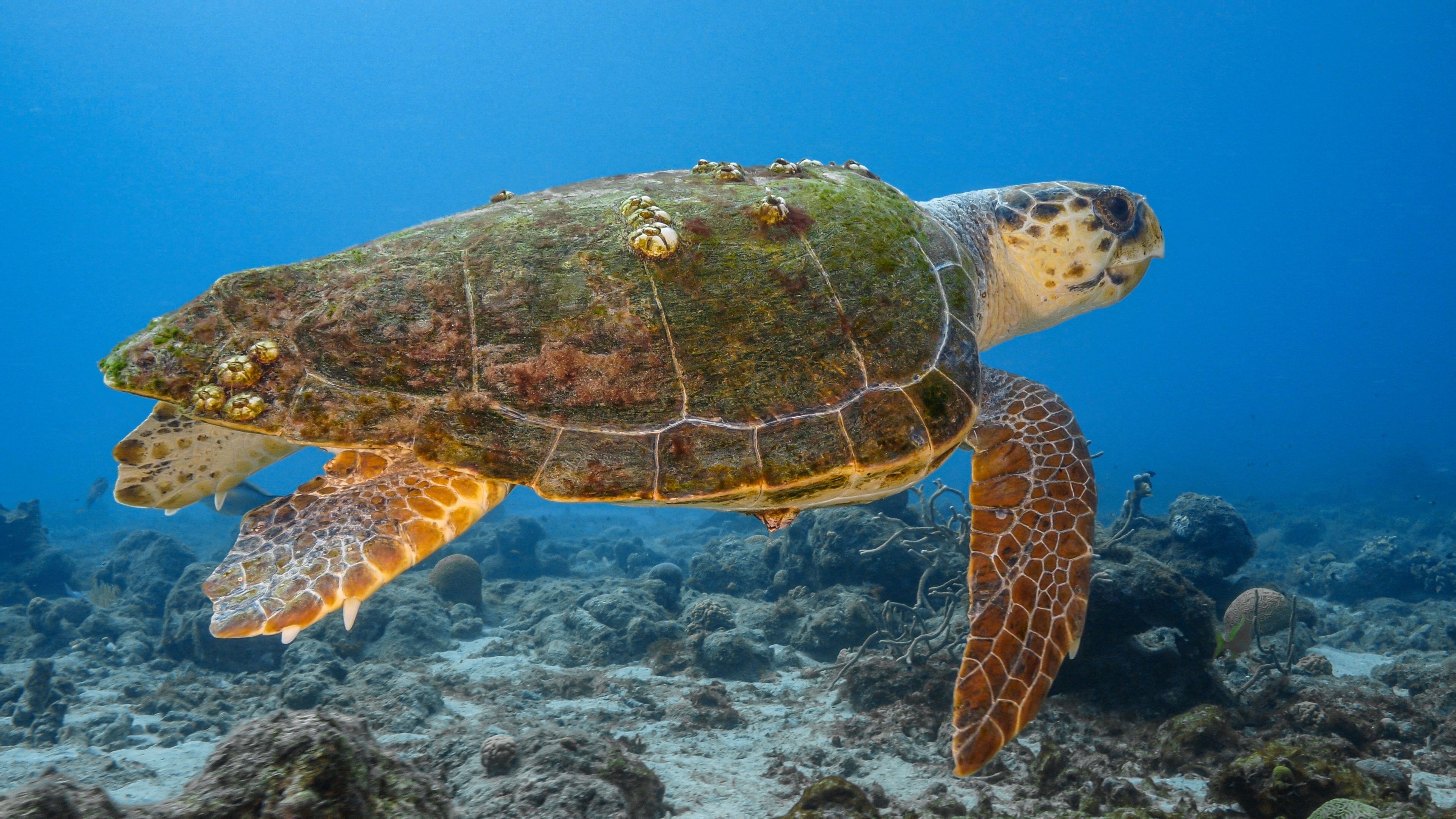
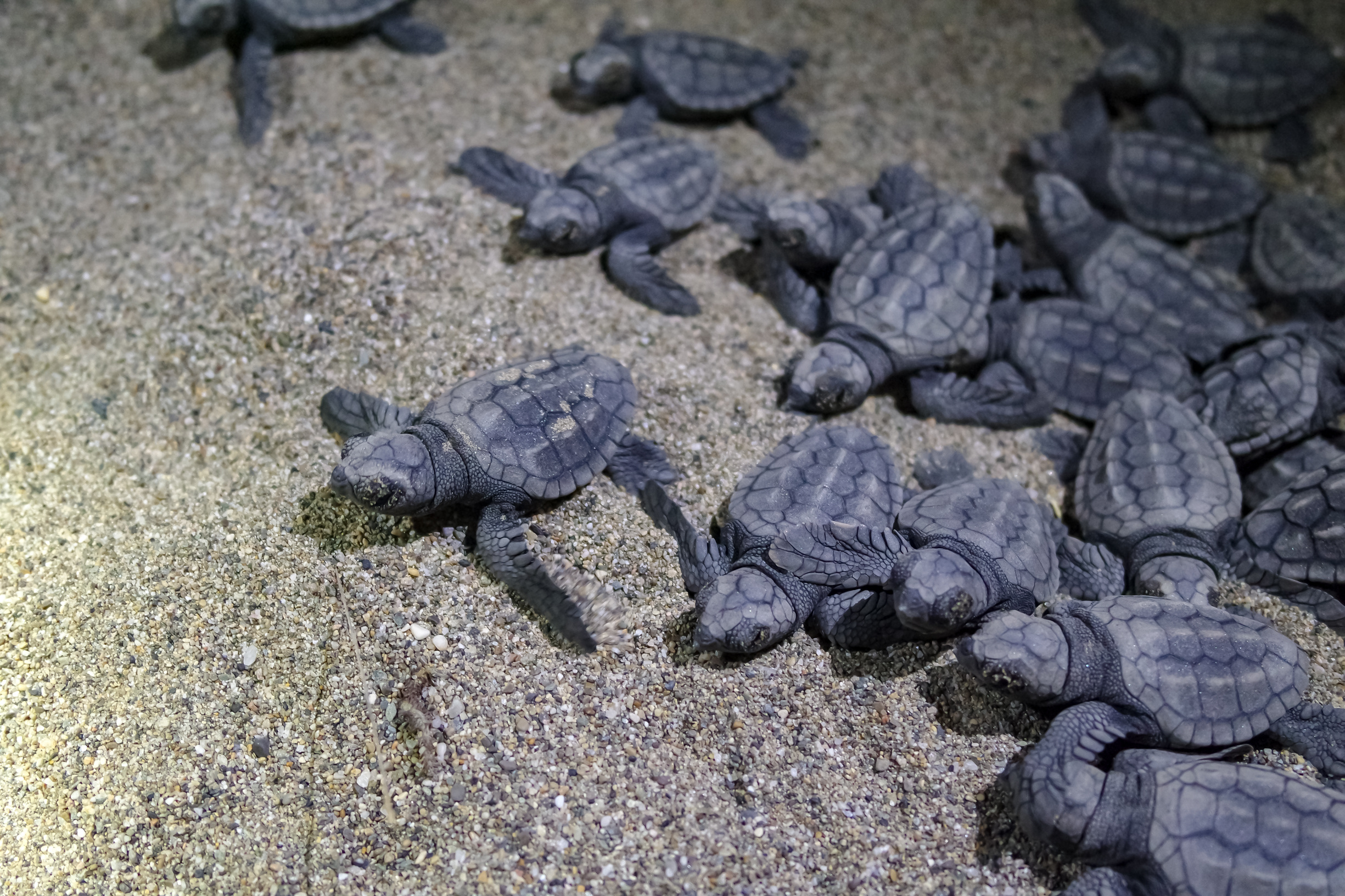
Loggerheads are named after their very large head with yellow cheeks and heavy strong jaws, and is the largest of all hard-shelled sea turtles. The carapace is heart-shaped and bony without ridges, and has large, non-overlapping, rough scutes present with 5 lateral scutes. The carapace is a reddish-brown with a yellowish-brown plastron. Their front flippers are short and thick with 2 claws each, while the rear flippers can each have 2 or 3 claws. Hatchlings have a dark-brown carapace with flippers pale brown on the margins.
Size
Adults typically measure between 0.8 and 1.2 metres in carapace length.
Weight
Adults weigh between 70 and 180 kilograms.
Lifespan
Loggerheads are estimated to live between 70 and 80 years or more.
Diet
Loggerheads are primarily carnivorous and feed mostly on shellfish that live on the bottom of the ocean. They eat horseshoe crabs, conchs, clams, bivalves, whelks, mussels, molluscs and other benthic invertebrates. Their powerful jaw muscles help them to easily crush shellfish. They also occasionally feed on jellyfish, shrimp, sponges, fish, and sometimes even seaweed and sargassum (brown seaweed with berry-like air bladders). The calcium from the consumption of shellfish is consequently excreted and deposited on the ocean floor as a source of calcium for other animals.
Range
Loggerheads are found mostly in tropical and sub-tropical waters around the world, venturing into temperate waters to forage. They are the most common species in the Mediterranean but are also found in the Atlantic, Indian and Pacific Oceans. Loggerheads are the second most widely distributed sea turtle species after the Leatherback.
Habitat
Loggerheads prefer to feed in coastal bays and estuaries, as well as in the shallow waters along the continental shelves of the Atlantic, Pacific and Indian Oceans, but they are also very pelagic, especially juveniles. Loggerheads spend most of their time within the top 5 metres of the water column, where they have been observed feeding on jellyfish. Loggerheads also dive below the thermocline for up to 30 minutes at a time to feed on shellfish before returning to warmer surface waters to thermoregulate.
Nesting
- Reproduction Interval: 2-4 years
- Clutches Per Season: 3-6 clutches (at 12-14 day intervals)
- Clutch Size: 100-126 eggs
- Egg Size and Weight: 4 centimetres in diameter, 36 grams
- Nest Incubation Period: 60 days
- Sexual Maturity: 20 years / 50 to 87 centimetres in carapace length
The largest concentration of nesting occurs on Masirah Island off the coast of Oman, with an estimated 30,000 nests laid per year. In the Mediterranean, Loggerheads nest on Beaches in Greece, Turkey and Israel; in the Atlantic, the main concentration occurs in Florida; and in the Pacific, their main nesting grounds are Japan and Australia.
Population Estimates
Between 40,000 and 50,000 nesting females.
Status
International: Listed as Vulnerable (facing a high risk of extinction in the wild in the near future) by the International Union for Conservation of Nature and Natural Resources.
USA: Listed as Threatened (likely to become endangered, in danger of extinction, within the foreseeable future) under the Federal US Endangered Species Act of 1973.
Interesting Facts
- One population of Loggerheads nests in Japan and migrates across the Pacific Ocean to forage and mature off the coast of Baja California Sur, Mexico.
- In the US, most of their nests are laid in Florida, however, in the last decade the number of nests in Florida has declined by 40%.
- Loggerheads leave asymmetrical or ‘zipper’ tracks with an average width of 80-90 centimetres when they crawl up onto the beach. These are created when the turtle moves one flipper forward at a time. Since Loggerheads are heavier than other turtles that also produce asymmetrical tracks, they also create a deeper body pit.
- Loggerheads carry many organisms on their carapace such as barnacles and crabs. Scientists have identified between 50 and 100 species of plant and invertebrate animals hitching a ride. These hitchhikers are called epibionts.
- Loggerheads are the second most widely distributed sea turtle species after the Leatherback.
- Loggerheads exhibit trans-oceanic developmental migrations from nesting beaches to pre-mature foraging areas on opposite sides of ocean basins.
- A large juvenile Loggerhead named Adelita was the first sea turtle to be tracked by satellite across an entire ocean basin from feeding areas off Baja California, Mexico, to coastal areas off her natal Japan.
- In the North Atlantic Ocean, post-hatchlings and small juveniles associate with mats of sargassum for years before returning back to nearshore areas off the eastern coast of the US as large pre-matures.
References
ECOMAR: Species
Gnaraloo Wilderness Foundation
IUCN Red List: Loggerhead Sea Turtle
National Geographic: Loggerhead Sea Turtle
NOAA Fisheries: Loggerhead Sea Turtle
Sea Turtle Conservancy: Loggerhead Sea Turtle
See Turtles: Loggerhead Sea Turtle
SWOT: Loggerhead Sea Turtle
Upwell: Loggerhead Sea Turtle
 Koru Honu