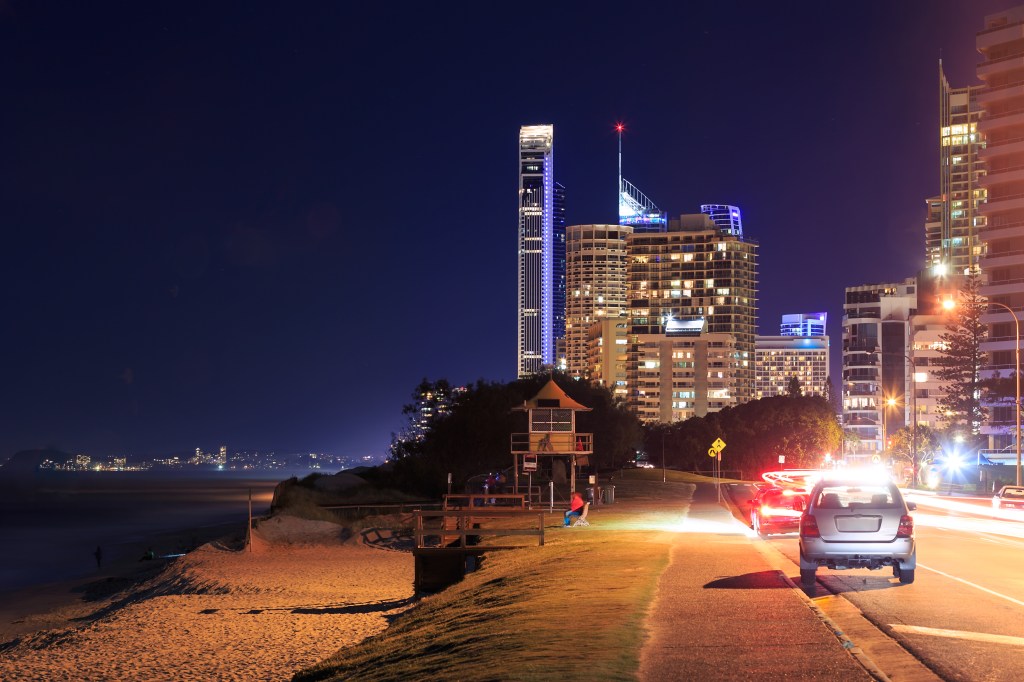
During breeding season, female sea turtles come to shore to nest at night when they and their eggs are less vulnerable to threats and dangers. However, over the decades, beaches around the world are now more and more lined with beachside condominiums, houses and hotels. Lights from these buildings and businesses discourage females from nesting. Researchers have found that artificial lighting reduces the nesting success of Loggerheads by 20%. If a female fails to nest after multiple crawls, she will resort to nesting on a beach with less than ideal nesting conditions or deposit her eggs in the ocean, both with slim chances of survival for hatchlings. There have also been cases of artificial lighting disorienting nesting females where they end up on roads, and in some cases, struck by oncoming vehicles.
The implications of artificial lighting on hatchlings is also important. Eggs hatch at night when it is cooler and safer from predators. As soon as hatchlings leave their eggs, they rapidly make their way towards the ocean guided by the low bright lights of the moon and night sky reflecting off the water. As a result of coastal development however, artificial lights have misguided hatchlings away from the sea, often resulting in the death of the hatchlings from dessication, predation or oncoming traffic before they can find their way back to the ocean. Even a single bright light near a nesting site can cause all or most of the hatchlings on a given beach to head inland. Along developed coastlines, zig-zagging tracks in the sand are often observed indicating the presence of disoriented and confused hatchlings. At times, hatchlings as well as nesting females have ended up in swimming pools of resorts and condominiums. Artificial lights also have the potential to increase the abundance in ghost crabs which heavily prey on eggs and hatchlings.
Summary
- Female sea turtles nest at night when they and their eggs are less vulnerable to threats and dangers. Lights from beachside developments discourage females from nesting, resulting in females laying their eggs in less than ideal locations.
- Artificial lighting has been observed to disorient nesting females where they end up in swimming pools or on roads, and sometimes struck by oncoming vehicles.
- Artificial lighting has also misguided hatchlings away from the sea, often resulting in the death of the hatchlings from dessication, predation or oncoming traffic.
- Artificial lights also have the potential to increase the abundance of ghost crabs which heavily prey on eggs and hatchlings.
Solution
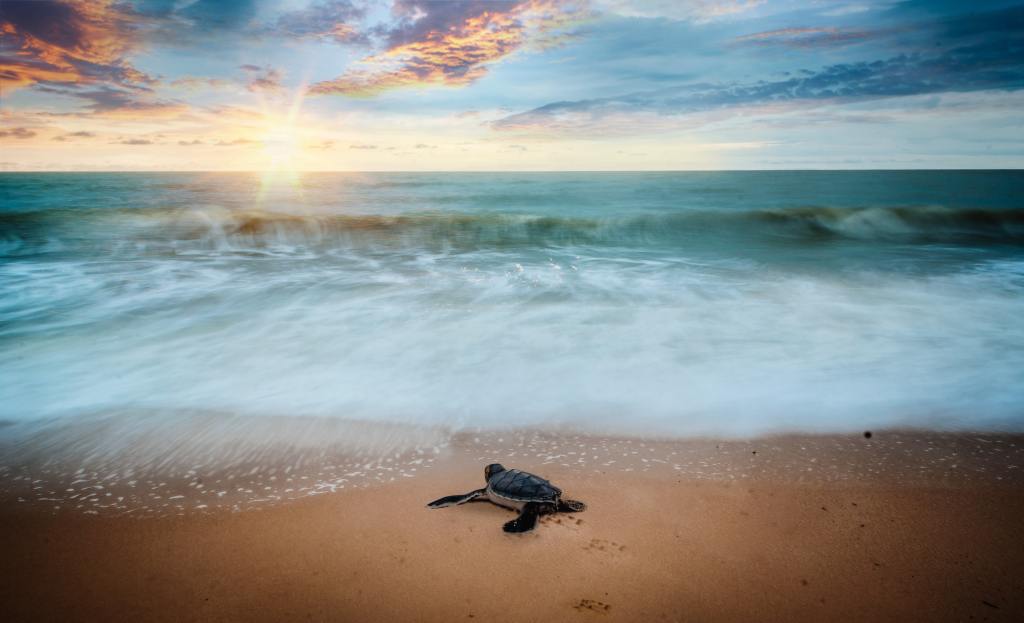
Coastal communities around the world have passed ordinances that require residents turn off beachfront lights during turtle nesting season. Unfortunately, these ordinances are not always enforced and don’t address the problem of sky glow that occurs near cities. The first step to mitigating light pollution that affects sea turtles is to turn off or reduce the amount of light visible from nesting beaches. This is one of the least expensive ways we can support sea turtles and can actually save money in electricity costs. On top of that, humans can once again see the wonders of the night sky, a natural and beautiful experience that many people have forgotten exists.
If external lights are necessary for security and safety reasons, use turtle-safe lights, such as low-pressure sodium-vapor lighting (LPS), with special fixtures to shield the lights from the beach. These red lights emit a very narrow portion of the visible light spectrum, which is less intrusive to nesting sea turtles and hatchlings.
To prevent internal lighting from being visible from the beach, turn off indoor lights when not in use, tint windows, and close opaque curtains or blinds after dark to not only cover windows visible from the beach, but all windows as light pollution affects other types of wildlife including bats, birds and insects.
If disoriented hatchlings and/or adult sea turtles are found beyond the boundary of the beach, call the relevant local authorities and remove or guide the hatchlings or nesting turtles out of harm’s way in the direction of the ocean. It is important that the relevant local authorities are notified so that they can rectify the problem to prevent sea turtles from being put in danger again.
Education is vital to encourage people to turn off their lights and implement recommendations. People typically are more willing to take action when they understand the cause. The Sea Turtle Conservancy implemented an education programme on beach lighting in Florida, where 90% of sea turtle nesting in the US takes place. In 1999, at Gulf Islands National Seashore, 33 of 65 nests (51%) that hatched had levels of disorientation where at least a quarter of the hatchlings emerging from the nest cued in on the wrong direction. The following year, after educating the pubic about light pollution, 26 of 58 nests (45%) that hatched were disoriented. A 6% reduction after only one year exemplifies how educating the public about light pollution can directly benefit sea turtles.
Finally, it is vital that policies are put in place to stop further new construction within proximity to beaches. This means a no-build buffer zone of the coast, and implemented as part of construction set-back policies and legislation around the world (see Coastal Developments). Where buildings already exist, the above lighting recommendations should be implemented, and over time as human population eventually declines, we can return the land we built on to the natural inhabitants of the coast.
Summary
- Coastal communities around the world have passed ordinances that require residents turn off beachfront lights during turtle nesting season, but these are not always enforced.
- Turning off lights is one of the least expensive solutions and allows humans to once again see the wonders of the night sky.
- For security lights, use turtle-safe lights, such as low-pressure sodium-vapor lighting (LPS), with special fixtures to shield the lights from the beach. These red lights emit a very narrow portion of the visible light spectrum for sea turtles.
- Turn off indoor lights when not in use, tint windows, and close opaque curtains or blinds after dark to prevent internal lights from spilling out.
- Call the relevant local authorities and remove or guide the hatchlings or nesting turtles out of harm’s way in the direction of the ocean if disoriented hatchlings and/or adult sea turtles are found beyond the boundary of the beach.
- Educate the public to encourage people to turn off their lights and implement recommendations.
- Establish a no-build buffer zone of the coast, and implemented as part of construction set-back policies and legislation around the world (see Coastal Developments).
- As human population eventually declines, we can return the land we built on to the natural inhabitants of the coast.
References
Colman, L. P., Lara, P. H., Bennie, J. et al. Assessing Coastal Artificial Light and Potential Exposure of Wildlife at a National Scale: The Case of Marine Turtles in Brazil. Biodiversity and Conservation 29(2), 1135-1152 (2020).
Earth.com: Tourism can Worsen Deadly Light Pollution in Sea Turtle Habitats
Florida Fish and Wildlife Conservation Commission: Artificial Lighting and Sea Turtle Hatchling Behaviour
International Dark-Sky Association: Sea Turtle Conservation
NFWF: Keeping Sea Turtles in the Dark
Sea Turtle Conservancy: Threats from Artificial Lighting
Sella, K. N., Sicius, L. & Fuentes, M. M. P. B. Using Expert Elicitation to Determine the Relative Impact of Coastal Modifications on Marine Turtle Nesting Grounds. Coastal Management 47(5), 492-506 (2019).
Silva, E., Marco, A., da Graça, J. et al. Light Pollution Affects Nesting Behavior of Loggerhead Turtles and Predation Risk of Nests and Hatchlings. Journal of Photochemistry and Photobiology B: Biology 173, 240-249 (2017).
Wildlife Sense: Light Pollution – The Invisible Threat to Sea Turtles
Windle, A. E., Hooley, D. S. & Johnston, D. W. Robotic Vehicles Enable High-Resolution Light Pollution Sampling of Sea Turtle Nesting Beaches. Frontiers in Marine Science 6(493), 1-11 (2018).
Witherington, B. E., Martin, R. E. & Trindell, R. N. Understanding, Assessing and Resolving Light Pollution Problems on Sea Turtle Nesting Beaches. Florida Fish and Wildlife Research Institute Technical Report (2014).
 Koru Honu