Common Name
Leatherback Sea Turtle
Scientific Name
Dermochelys coriacea
Description
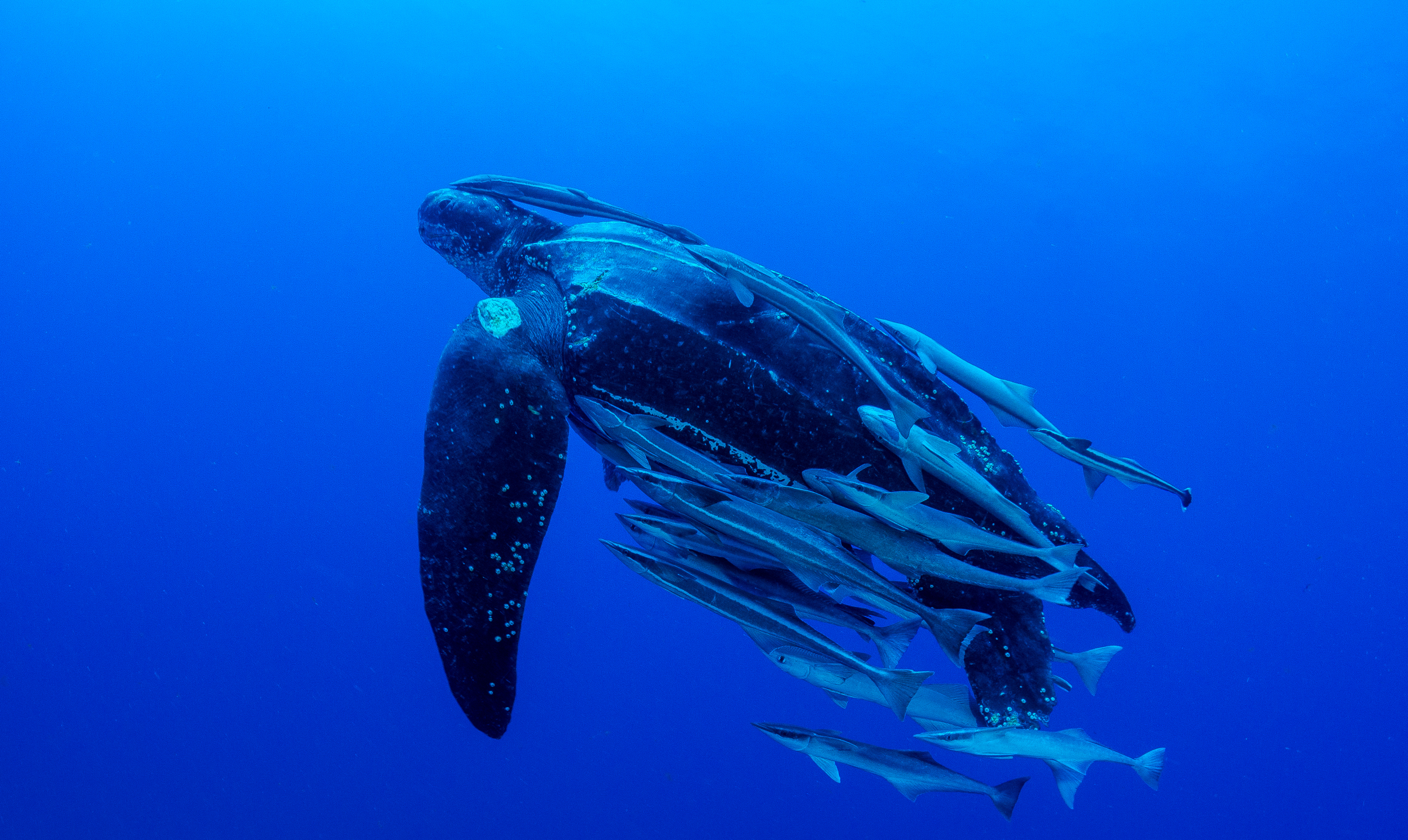
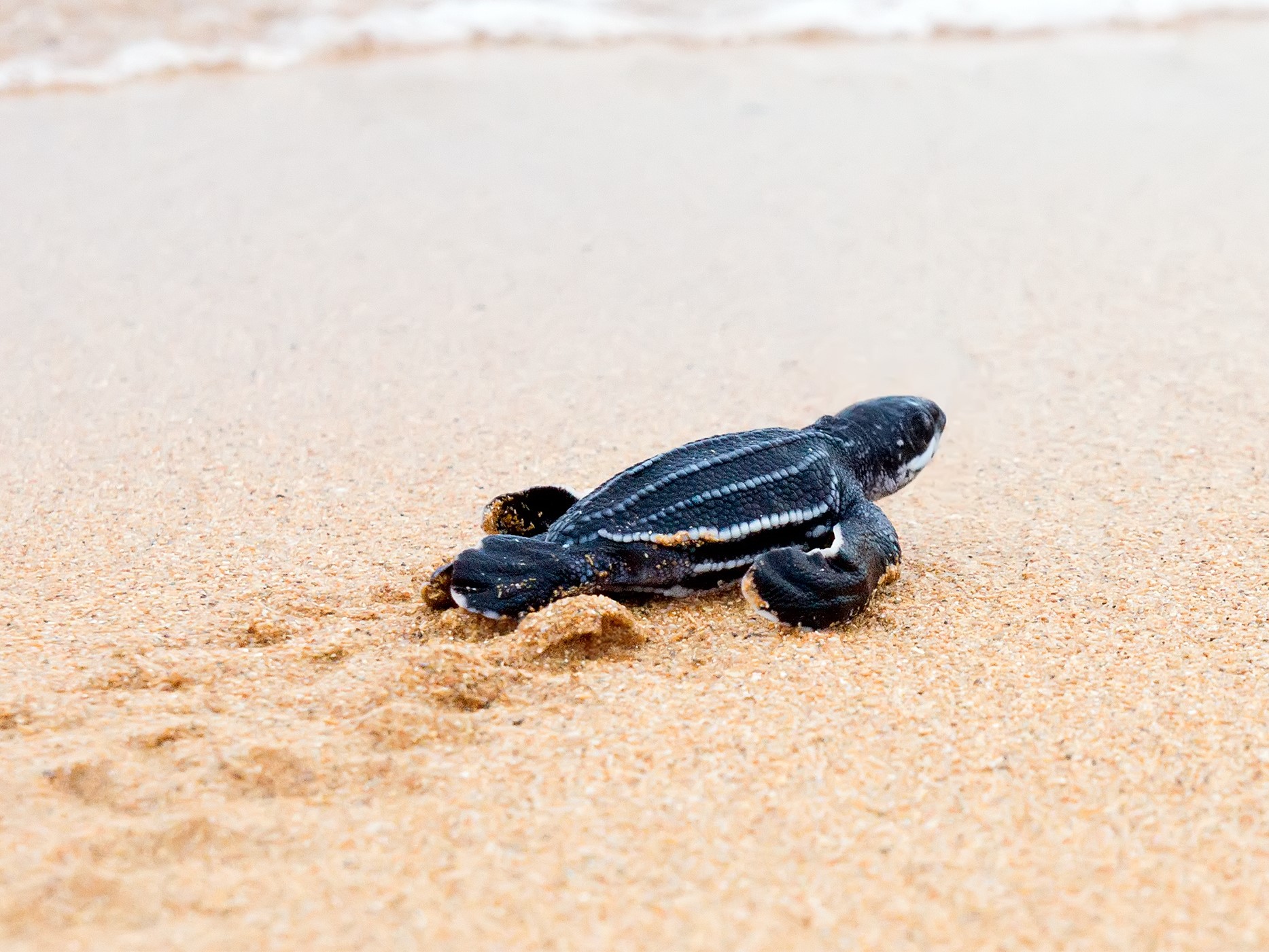
The Leatherback Sea Turtle is named after its unique shell which is composed of a thin layer of tough, rubbery skin, strengthened by thousands of tiny bone plates that make it look “leathery”. Its carapace is large, elongated and flexible with 7 distinct ridges running its length. It is dark grey or black with white or pale spots, while the plastron is whitish to black and marked by 5 ridges. The Leatherback is the only sea turtle that lacks a hard shell. Hatchlings are born with white blotches and scales on their carapace, which the latter then disappear as they mature. Leatherbacks do not have claws on their flippers, and they have a blunt head with a visible pineal gland or ‘pink spot’, and a deeply notched upper jaw with two cusps.
Size
Adults measure between 1.30 and 2.4 metres in length.
The largest Leatherback ever recorded was 3 metres from the tip of its beak to the tip of its tail and weighed 916 kg.
Weight
Adults weigh between 300 and 500 kilograms.
Lifespan
Very little is known of the Leatherbacks’ lifespan. Reports suggest they can live more than 100 years.
Diet
Leatherbacks have delicate, scissor-like jaws. Their jaws would be damaged by anything other than a diet of soft-bodied animals, so they feed almost exclusively on jellyfish, tunicates, gelatinous zooplankton and other soft-bodied invertebrates such as salps, siphonophores and pyrosomes. It is remarkable that this large, active animal can survive on a diet of jellyfish, tunicates and gelatinous zooplankton, which are composed mostly of water and appear to be a poor source of nutrients. Leatherbacks migrate extensively to forage and typically forage in the top 300 metres of the water column, but have been known to dive to deeper depths.
Range
The Leatherback is the most widely distributed of all sea turtles; found worldwide with the largest north and south range of all the sea turtle species. In the Pacific, their range extends as far north as Alaska and south beyond the southern-most tip of New Zealand. In the Atlantic, they can be found as far north as Norway and the Arctic Circle and south to the tip of Africa. They are also found in the Indian Ocean. Its streamlined body shape and powerful front flippers makes it possible for a leatherback to swim thousands of miles over open ocean and against fast currents. They are mainly pelagic wanderers and foragers, but migrate to tropical and subtropical coastal regions to mate and nest.
Habitat
Leatherbacks are primarily found in the open ocean, as far north as Alaska and as far south as the southern tip of Africa, though recent satellite tracking research indicates that leatherbacks feed in areas just offshore. Known to be active in water near freezing, it is the only reptile known to remain active at such low temperatures.
Nesting
- Reproduction Interval: 2-3 years (though recent research has indicated that they can nest every year)
- Clutches Per Season: 4-7 clutches (with an average of 10 day intervals)
- Clutch Size: 80 larger fertilised eggs and 30 smaller unfertilised eggs
- Egg Size and Weight: 5.3 centimetres in diameter, 90 grams
- Nest Incubation Period: 65 days
- Sexual Maturity: 15 years / 145 to 160 centimetres in carapace length
Leatherbacks undertake the longest migrations between breeding and feeding areas of any sea turtle, averaging 3,700 miles each way. Nesting occurs in the tropics. Unlike other species of sea turtles, leatherback females may change nesting beaches, though they tend to stay in the same region. Hatchling Leatherbacks are the only species to hatch in autumn and winter. All other species hatch in the warmest month.
Population Estimates
Between 34,000 and 36,000 nesting females.
Status
International: Listed as Vulnerable in 2013 (facing a high risk of extinction in the wild in the immediate future) by the International Union for Conservation of Nature and Natural Resources.
USA: Listed as Endangered (in danger of extinction within the foreseeable future) in 1970 under the US Endangered Species Conservation Act of 1969, the predecessor to the Federal US Endangered Species Act of 1973.
Interesting Facts
- The Leatherback population in the Atlantic appears to be stable, but the Pacific population has declined 90% in the last two decades.
- The largest Leatherback ever recorded was 3 metres from the tip of its beak to the tip of its tail and weighed 916 kg. It was estimated to be about 100 years old. It had washed up dead on the coast of Wales in 1988, drowned from entanglement in fishing gear.
- Adult Leatherbacks leave symmetrical tracks with an average width of 150-230 centimetres (or larger!) when they crawl up onto the beach. These are created when the turtle moves both front flippers forward simultaneously.
- Leatherbacks mostly forage in the top 300 metres of the water column and typically dive for 20-30 minutes at a time, but scientists have recorded Leatherbacks diving as deep as 1,200 metres in search of gelatinous zooplankton at dive intervals of 86 minutes on a single breath. Sperm Whales, Beaked Whales, and Elephant Seals are the only other known animals that dive deeper.
- Their unique smooth, rubbery carapace, which can compress at depth, allows them to dive to great depths unlike other species of sea turtles.
- The longest Leatherback migration was recorded to be 21,000 kilometres one way.
- An adult female was tracked using satellite telemetry travelling more than 19,000 kilometres from Indonesia to Oregon, one of the longest migrations of any vertebrate animal ever recorded.
- The Leatherback is the oldest of all sea turtles, and has been around for more than 150 million years. They survived the extinction of the dinosaurs and thrived until the last several decades when human interactions have taken a major toll.
- Leatherbacks can consume about 73% of their own body weight in prey per day, feeding exclusively on soft-bodied invertebrates like jellyfish and tunicates.
- Leatherbacks have downward curving spines (also known as papillae) in their mouth and throat which help them to capture and swallow their prey.
- Their widespread distribution and ability to tolerate cold water are due to thermoregulatory adaptations (called gigantothermy) which allow them to maintain their core body temperature. These adaptations include their large body size, changes in activity and metabolic rate, peripheral insulation (fat) and adjustments in blood flow.
- Their visible pinal gland or ‘pink spot’ on the top of their heads affects sleep patterns when it detects changes in day length signalling seasonal changes (together with water temperature), thus assisting with migration time.
- The leatherback is the only remaining member of its taxonomic family, Dermochelyidae.
References
ECOMAR: Species
Gnaraloo Wilderness Foundation
IUCN Red List: Leatherback Sea Turtle
National Geographic: Leatherback Sea Turtle
NOAA Fisheries: Leatherback Sea Turtle
Sea Turtle Conservancy: Leatherback Sea Turtle
See Turtles: Leatherback Sea Turtle
SWOT: Leatherback Sea Turtle
Upwell: Leatherback Sea Turtle
 Koru Honu