Common Name
Kemp’s Ridley Sea Turtle
Scientific Name
Lepidochelys kempii
Description
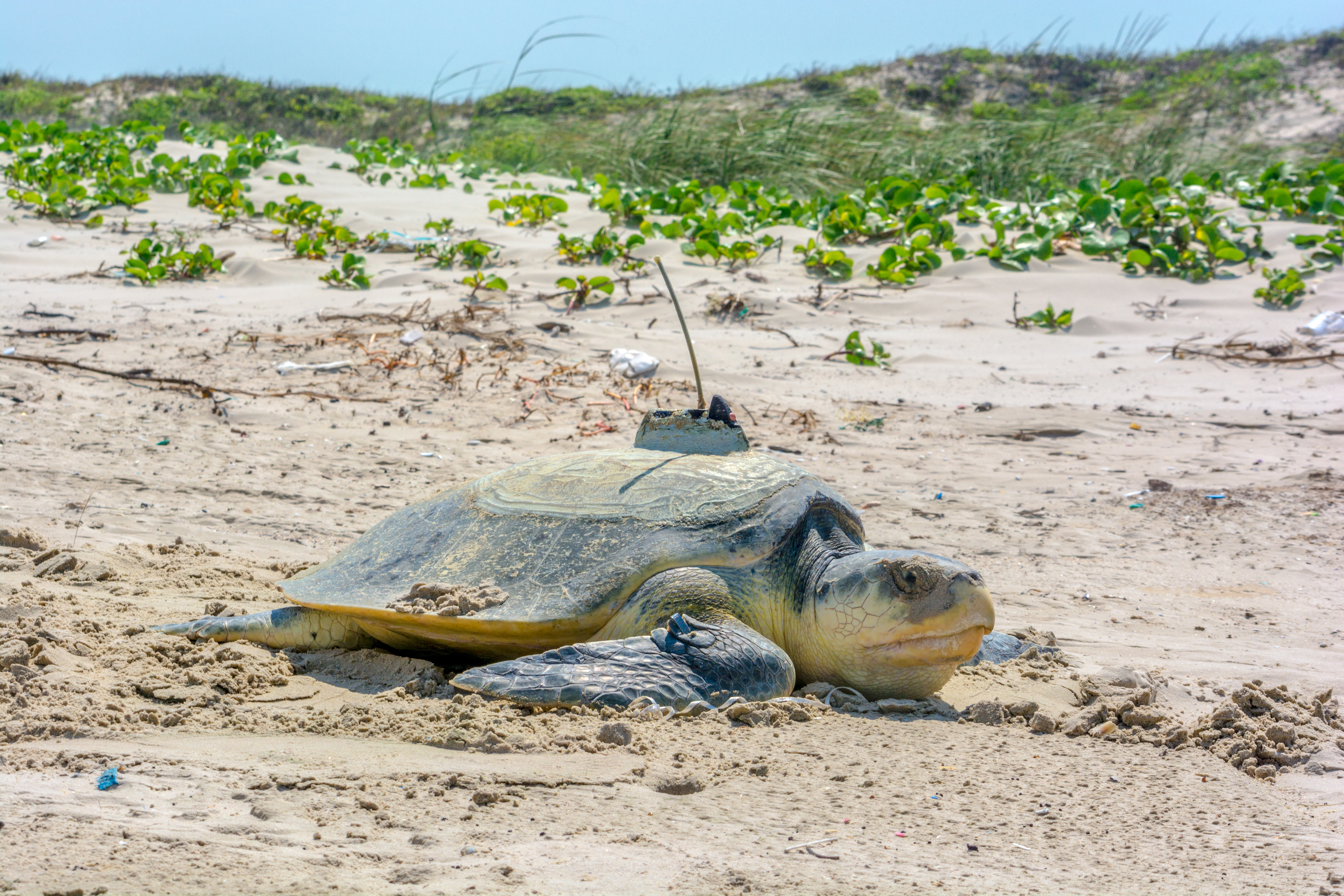
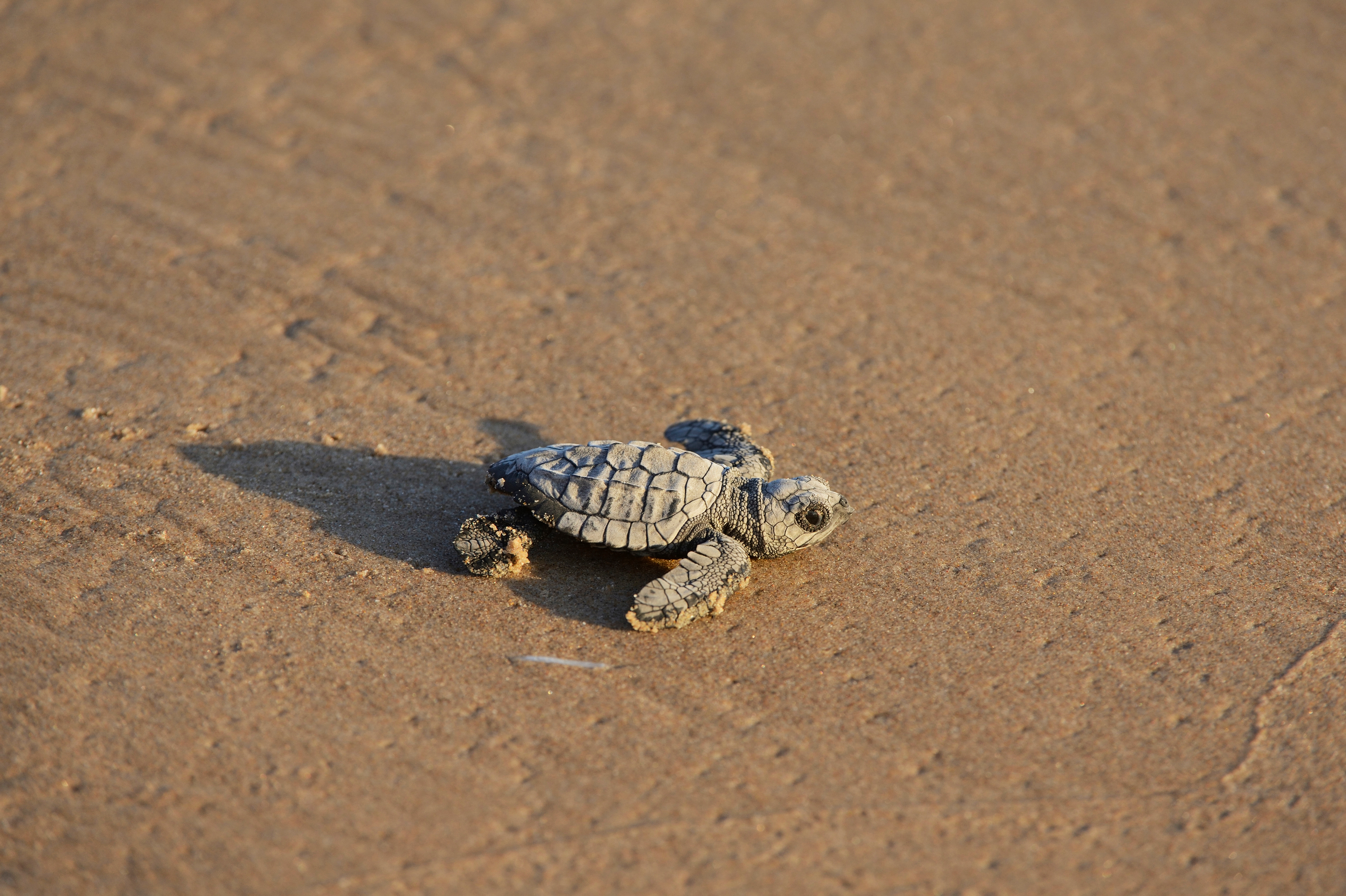
Kemp’s Ridleys are the smallest sea turtles in the world and are named after Richard M. Kemp, a fisherman from Florida who first discovered the species in 1906 and helped study it. Kemp’s Ridleys have moderate-sized heads, triangular in shape with hooked beaks and strong jaws. Front flippers have 1 claw each, while the rear flippers each have 1 or 2 claws. The carapace is rounded and bony without ridges and has large, non-overlapping scutes present with 5 very rounded lateral scutes. Adults have a dark grey-green carapace with a white or yellowish plastron, while hatchlings are jet black.
Size
Adults measure on average around 0.6 metres in carapace length.
The Kemp’s Ridley is the smallest of the sea turtle species.
Weight
Adults weigh between 32 and 49 kilograms.
Lifespan
Not much is known about the lifespan of Kemp’s Ridleys, but it is estimated that they live for at least 30 years, likely longer.
Diet
Kemp’s Ridleys have powerful jaws that help them to crush and grind crabs (especially juveniles), clams, mussels, shrimp and other molluscs. They also like to eat fish, sea urchins, squid and jellyfish.
Range
Adults are mostly limited to the Gulf of Mexico, but are also found in the Caribbean and along the Atlantic coast as far north as Nova Scotia. Juveniles range between tropical and temperate coastal areas of the northwest Atlantic Ocean, and can be found up and down the east coast of the US.
Habitat
Kemp’s Ridleys prefer shallow areas with sandy and muddy bottoms.
Nesting
- Reproduction Interval: 1-3 years
- Clutches Per Season: 2-3 clutches
- Clutch Size: 110 eggs
- Nest Incubation Period: 55 days
- Sexual Maturity: 10-17 years (females); 11-30 years (males)
Kemp’s Ridleys are the only sea turtle species (along with the Olive Ridley, and to a lesser extent Flatbacks) to nest primarily during the day. Like the Olive Ridley, Kemp’s Ridleys nest in mass synchronised nestings called arribadas (Spanish for “arrival”) where thousands of females nest together. Approximately 95% of nesting occurs at Rancho Nuevo in the state of Tamaulipas in Mexico, but also occur in Texas along the Padre Island National Seashore as well as further north along the Texas coast.
Population Estimates
Between 7,000 and 9,000 nesting females.
Status
International: Listed as Critically Endangered (facing an extremely high risk of extinction in the wild in the immediate future) by the International Union for Conservation of Nature and Natural Resources.
USA: Listed as Endangered (in danger of extinction within the foreseeable future) in 1970 under the US Endangered Species Conservation Act of 1969, the predecessor to the Federal US Endangered Species Act of 1973.
Interesting Facts
- The Kemp’s Ridley is the smallest of the sea turtle species.
- Kemp’s Ridleys can experience cold stunning when water temperatures drop rapidly or unexpectedly.
- Kemp’s Ridleys leave asymmetrical or ‘zipper’ tracks with an average width of 70-80 centimetres (same as the Olive Ridley) when they crawl up onto the beach. These are created when the turtle moves one flipper forward at a time.
- Along with the Olive Ridley, and to a lesser extent Flatbacks, the Kemp’s Ridley is the only sea turtle species to nest primarily during the day.
- In 1947 an arribada of more than 40,000 Kemp’s ridleys was filmed at Rancho Nuevo, Mexico. However, in the 1980s, a low of around 200 nesting Kemp’s Ridleys were documented on the same beaches. Since then, the population appears to be making a slow but steady comeback thanks to strict laws protecting the nesting beaches of Mexico and the use of Turtle Excluder Devices on commercial trawlers. Today, there is an etimated 7,000 to 9,000 nesting females.
- An incredible bi-national effort has been made to save Kemp’s Ridleys from extinction by translocating eggs from beaches in Mexico to beaches in Texas, and by giving juvenile Kemp’s Ridleys a ‘head-start’, whereby hatchling turtles are grown in captivity to larger sizes before being released in an attempt to mitigate predation effects.
- Hatchlings dispersing from nesting beaches along the Gulf of Mexico may spend up to two years navigating currents in the Atlantic. Nesting sites with currents facilitating rapid movement into deeper waters with fewer predators, and dispersal to suitable feeding grounds lead to improved survival.
References
ECOMAR: Species
NOAA Fisheries: Kemp’s Ridley Sea Turtle
Sea Turtle Conservancy: Kemp’s Ridley Sea Turtle
See Turtles: Kemp’s Ridley Sea Turtle
SWOT: Kemp’s Ridley Sea Turtle
Upwell: Kemp’s Ridley Sea Turtle
 Koru Honu