Common Name
Hawksbill Sea Turtle
Scientific Name
Eretmochelys imbricata
Description
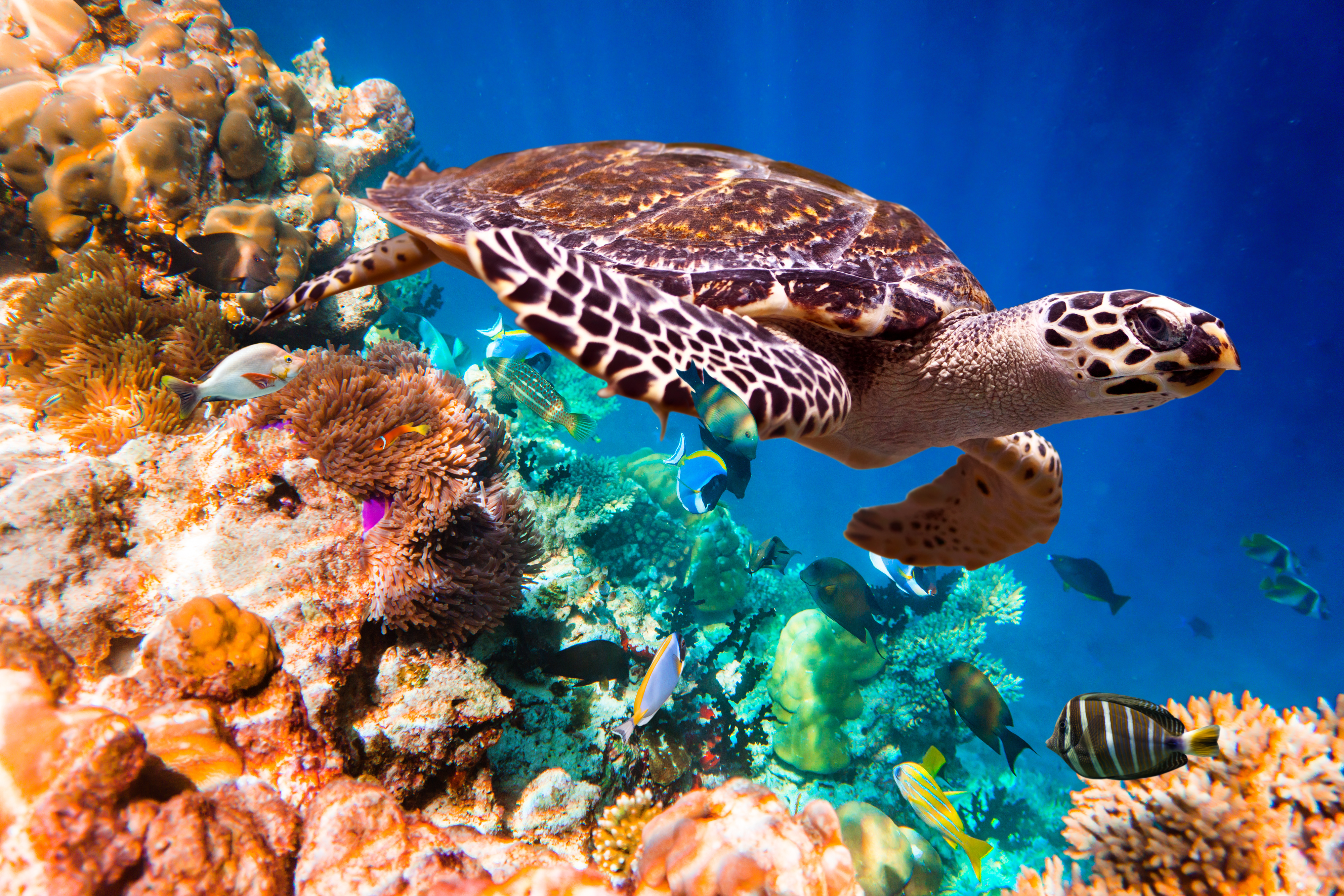
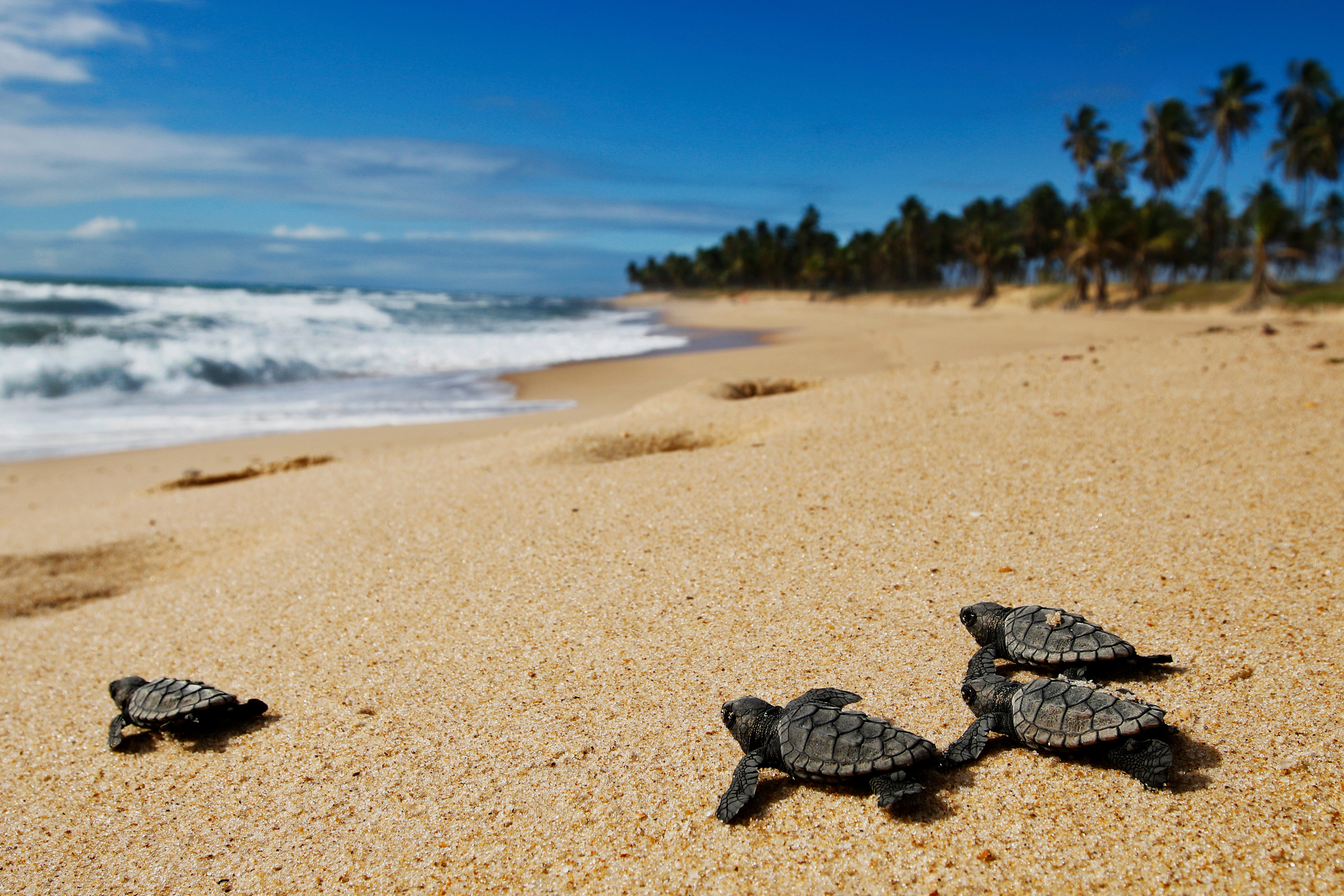
The Hawksbill is named after its narrow head and bird-like beak. It has 2 pairs of prefrontal scales and its jaw is not serrated. Flippers have 2 claws each. The Hawksbill is one of the smaller sea turtles. The carapace is elliptical in shape, bony without ridges and has large, over-lapping scutes present with 4 lateral scutes. Adult carapaces are orange, brown or yellow with radiant streaks of orange or red, while hatchlings are mostly brown with pale blotches on scutes.
Size
Adults measure between 0.7 and 0.9 metres in carapace length.
Weight
Adults weigh between 45 and 90 kilograms.
Lifespan
Hawksbills are estimated to live between 50 and 60 years or more.
Diet
The Hawksbill’s narrow head and jaws shaped like a beak allow it to get food from crevices in coral reefs. They eat sponges, anemones, other sessile invertebrates associated with reefs, tunicates, mangrove shoots, algae, squid and shrimp. Hawksbills are able to digest invertebrate organisms whose bodies contain tiny indigestible glass needles.
Range
Tropical and sub-tropical waters of the Atlantic, Indian and Pacific Oceans. The largest populations occur in the Caribbean, the Seychelles, Indonesia, Mexico and Australia. Hawksbills are not found in the Mediterranean and only a handful nest in Florida each year. The Hawksbill is the most tropical of sea turtles.
Habitat
Hawksbills are typically found around coastal reefs, rocky areas, mangroves, estuaries, lagoons and oceanic islands. Hatchlings may venture into pelagic zones, seeking harbour in flotsam, or sometimes remain in mangrove estuaries, camouflaged among the fallen leaves. Juveniles and mature adults largely occupy coastal zones at depths of 20 metres or less.
Nesting
- Reproduction Interval: 2-4 years
- Clutches Per Season: 3-6 clutches (at 2 week intervals)
- Clutch Size: 160 eggs
- Egg Size and Weight: 3.8 centimetres in diameter, 28 grams
- Nest Incubation Period: 60 days
- Sexual Maturity: 20-40 years / 69 to 78 centimetres in carapace length
Hawksbills are solitary nesters. They nest in low densities on small, scattered and secluded low-beaches within beach vegetation. Adult females are well adapted for crawling over reefs and rocky areas to reach secluded nesting sites.
Population Estimates
Between 20,000 and 23,000 nesting females.
Status
International: Listed as Critically Endangered (facing an extremely high risk of extinction in the wild in the immediate future) by the International Union for Conservation of Nature and Natural Resources.
USA: Listed as Endangered (in danger of extinction within the foreseeable future) in 1970 under the US Endangered Species Conservation Act of 1969, the predecessor to the Federal US Endangered Species Act of 1973.
Interesting Facts
- Because of their sponge diet, the consumption of Hawksbill meat by humans can cause serious illness, and in extreme cases even death. Sponges contain toxic chemical compounds which accumulate in the Hawkbills’ tissues.
- Hawksbills play a vital role in marine ecosystems. By consuming sponges, they aid the growth of coral reefs. Without Hawksbills, sponges have the potential to overgrow and suffocate reefs. Hawksbills can consume about 500 kilograms of sponges per year.
- Hawksbills leave asymmetrical or ‘zipper’ tracks with an average width of 70-85 centimetres when they crawl up onto the beach. These are created when the turtle moves one flipper forward at a time.
- Some researchers believe that the Eastern Pacific Hawksbill is likely the most endangered sea turtle population worldwide.
- Hawksbills exhibit signs of biofluorescence on their shells, reflecting blue light back in fluorescent green and pink tones.
References
ECOMAR: Species
Gnaraloo Wilderness Foundation
IUCN Red List: Hawksbill Sea Turtle
NOAA Fisheries: Hawksbill Sea Turtle
Sea Turtle Conservancy: Hawksbill Sea Turtle
See Turtles: Hawksbill Sea Turtle
SWOT: Hawksbill Sea Turtle
Upwell: Hawksbill Sea Turtle
 Koru Honu