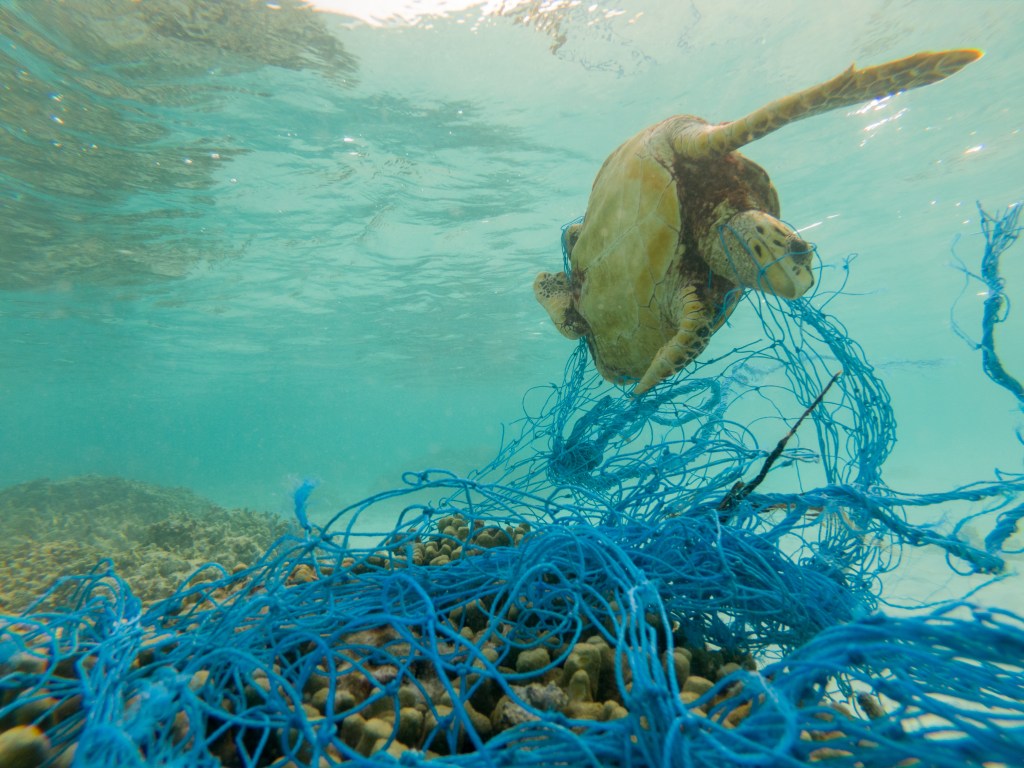
Entanglement and incidental capture in fishing gear has caused the death and injury of hundreds of thousands of marine animals worldwide. Approximately 40% of all animals caught in fisheries are incidental (known as by-catch) and discarded as trash. These animals are captured in trawls, longlines, driftnets, gill nets, pots and traps, and include sea turtles, marine mammals, sea birds, sharks, rays, crustaceans and other smaller marine animals. The global fishing fleet is currently 2.5 times larger than what oceans can sustainably support which shows how much of a threat commercial overfishing is to the marine environment.
Longlines contain thousands of baited hooks on lines that can be tens of kilometres long. Sea turtles are attracted to the bait and get caught and injured on the hooks or become entangled in the lines and drown. Hooks can also potentially get lodged in their digestive systems and cause a much slower death. Ropes and nets used by fisheries also entangle sea turtles causing external injuries, infections, strangulation, even amputation, and can prevent them from reaching the surface for air.
While live commercial fishing is a large threat to marine animals, the risk of ghost fishing is also considerably deadly. Ghost fishing is when fishing gear is abandoned, lost or discarded at sea. Some ghost nets get caught on the reef, consequently smothering coral and killing fish and other animals dependent on the reef. Other nets drift out into open water and subsequently trap larger marine animals such as sea turtles and whales. If these animals are not able to release themselves from the net, they eventually die from strangulation, drowning, starvation or even vessel collision by not being able to avoid vessels in time. Weighed down by the dead wildlife, the net sinks to the sea floor where scavengers feed thus removing carcasses from nets. Free of weight, the net subsequently rises towards the surface and the cycle of catching more animals continues until human intervention to remove the nets occurs.
Ghost gear is thought to increase its catch efficiency the longer it persists in the ocean as the initial catch often acts as bait, attracting larger marine animals.
Ghost gear can also become entangled with other gear and marine debris, forming a conglomerate. These conglomerates can become particularly destructive due to their complex nature, posing a deadlier risk to marine animals that get caught up in it.
Ghost gear is found in all marine habitats all around the world as they travel far and wide. This means that sea turtles are especially likely to encounter ghost gear thus putting them at risk. On nesting beaches, ghost gear may act as obstacles for both nesting females and her hatchlings. Nesting females may get entangled in fishing gear on her way ashore to nest while hatchlings may struggle to navigate their way to the sea. In foraging grounds, nets and other fishing gear that smother reefs and sea grass can entangle and/or injure feeding sea turtles. In the open ocean, sea turtles can mistake ghost gear for floating algal mats which they use for shelter and food, particularly among juveniles, thus causing them to become entangled and/or injured.
Entanglement isn’t the only problem with ghost fishing; other ghost gear including hooks and lines can be ingested by sea turtles and other marine animals causing internal injuries and death. Furthermore, ghost gear – especially nets – can travel for thousands of kilometres occupying a variety of different habitats. Overtime, microorganisms accumulate on ghost gear and ‘hitch-hike’ across ocean basins, thus encouraging the dispersal of invasive species and endangering marine ecosystems by potentially spreading diseases and parasites.
Sea turtles are also at risk of entanglement in plastic debris such as six-pack rings and plastic bags. For more information on the threat of plastic debris, see Plastic Pollution.
Summary
- Approximately 40% of all animals caught in fisheries (such as trawls, longlines, driftnets, gill nets, pots and traps) are incidental (known as by-catch) and discarded as trash.
- The global fishing fleet is currently 2.5 times larger than what oceans can sustainably support.
- Sea turtles are attracted to the bait on hooks from longlines, which they get caught on and injured or become entangled in the lines and drown.
- Hooks can also potentially get lodged in their digestive systems.
- Ropes and nets entangle sea turtles causing external injuries, infections, strangulation, even amputation, and can prevent them from reaching the surface for air.
- Ghost fishing is when fishing gear is abandoned, lost or discarded at sea.
- Some ghost nets get caught on the reef, consequently smothering coral and killing fish and other animals dependent on the reef.
- Other nets drift out into open water and trap larger marine animals such as sea turtles and whales, which eventually die from strangulation, drowning, starvation or even vessel collision if they are unable to release themselves.
- Ghost gear increases catch efficiency the longer it persists in the ocean as the initial catch often acts as bait, attracting larger marine animals.
- Ghost gear can also become entangled with other gear and marine debris, forming a conglomerate.
- On nesting beaches, nesting females may get entangled in ghost gear on her way ashore to nest, while hatchlings may struggle to navigate their way to the sea.
- As ghost gear travel far and wide, overtime, microorganisms accummulate and ‘hitch-hike’ across ocean basins, encouraging the dispersal of invasive species and endangering ecosystems by potentially spreading diseases and parasites.
- Sea turtles are also at risk of entanglement in plastic debris (see Plastic Pollution).
Solution
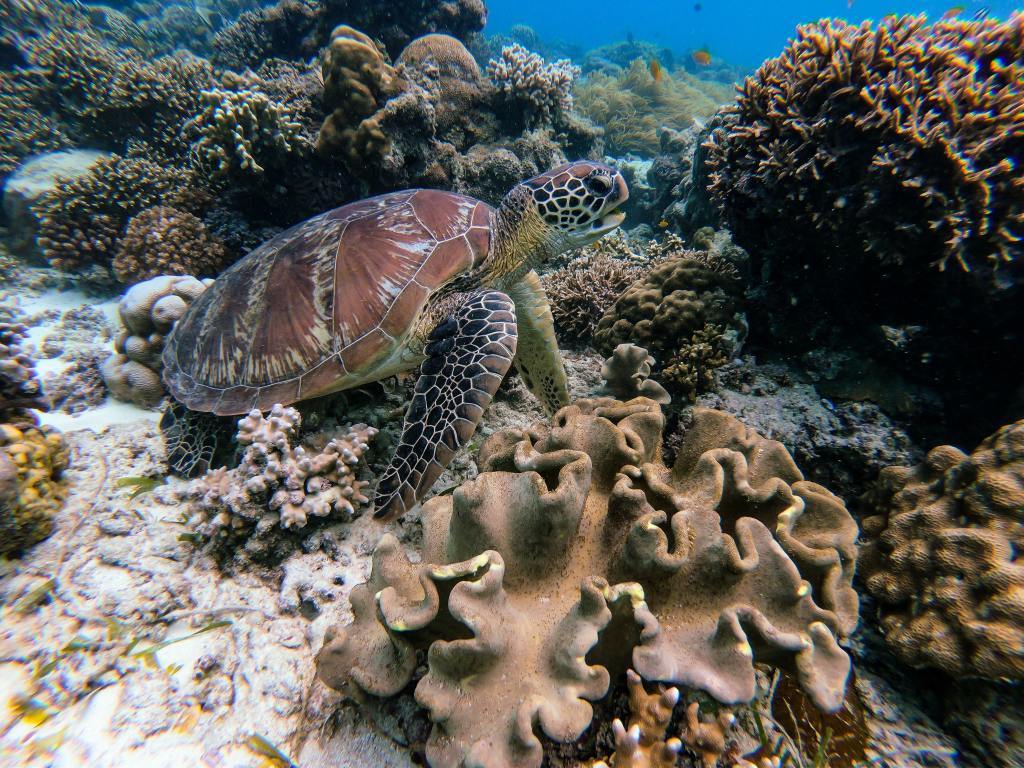
While the use of Turtle Excluder Devices (TEDs), two-dimensional net inserts with large escape openings, in trawl nets helps sea turtles escape if they are incidentally captured, a stronger solution would be to cease all commercial fishing to begin with. Commercial fishing affects all marine animals and is not sustainable to the natural marine ecosystem. Not only does it kill a lot of innocent animals, including those targeted, it affects the balance of the ecosystem when we remove food for other animals.
If you eat seafood, ensure you buy from local fisheries that fish responsibly by not fishing at commercial scale, replacing “J” hooks on lines with circle hooks to reduce the number and severity of by-catch and utilising smaller nets with TEDs. Nets and lines must also always be taken back to shore and not dumped at sea. It is also important for consumers to practice moderate seafood consumption, including limiting quantity and types of seafood consumed.
With commercial fishing ceased, local fishing must be limited to specific zones and times.
Farming of marine animals, including fish and crustaceans, should be banned. Raising animals born for the sole purpose of food, especially in cramped spaces, with their fate determined before they are even born, is a cruel and unnatural practice, and unbalances the natural ecosystem.
A major clean-up of all the ghost gear currently in the ocean is required to ensure sea turtles and other marine animals don’t get killed or injured anymore.
Education about the impacts entanglements and incidental capture have on sea turtles, other marine wildlife and their ecosystems, and why marine ecosystems are important, is vital to ensure people reduce or completely cut out their seafood consumption.
The amount of fishing gear in the oceans is also highly dependent on human population. As human population eventually declines, the demand for food from the ocean decreases and can be more easily managed.
Summary
- Cease all commercial fishing.
- If you eat seafood, ensure you buy from local fisheries that fish responsibly by not fishing at commercial scale, replacing “J” hooks on lines with circle hooks to reduce the number and severity of by-catch and utilising smaller nets with TEDs. Nets and lines must also always be taken back to shore and not dumped at sea.
- Local fishing must be limited to specific zones and times.
- Consumers must also practice moderate seafood consumption, including limiting quantity and types of seafood consumed.
- Marine farming should be prohibited.
- A clean-up of all existing ghost gear is required.
- Educate the public about the impacts entanglements and incidental capture have on sea turtles, other marine wildlife and their ecosystems, and why marine ecosystems are important.
- As human population eventually declines, the demand for food from the ocean decreases and can be more easily managed.
References
Dodge, K. L., Landry, S., Lynch, B. et al. Disentanglement Network Data to Characterize Leatherback Sea Turtle Dermochelys coriacea By-Catch in Fixed-Gear Fisheries. Endangered Species Research 47, 155-170 (2022).
Duncan, E. M., Botterell, Z. L. R., Broderick, A. C. et al. A Global Review of Marine Turtle Entanglement in Anthropogenic Debris: A Baseline for Further Action. Endangered Species Research 34, 431-448 (2017).
Kaufman, R. How Scientists Are Using Real-Time Data to Help Fishermen Avoid By-Catch. (Smithonian Magazine, 2019).
López-Mendilaharsu, M., Giffoni, B. B., Monteiro, D. et al. Multiple Threats Analysis for Loggerhead Sea Turtles in the Southwest Atlantic Ocean. Endangered Species Research 41, 183-196 (2020).
NOAA: Entanglement of Marine Life – Risks and Response
Olive Ridley Project: Ghost Fishing – A Cycle of Devastation
Olive Ridley Project: What are Ghost Nets?
Rodríguez, Y., Vandeperre, F., Santos, M. R. et al. Litter Ingestion and Entanglement in Green Turtles: An Analysis of Two Decades of Stranding Events in the NE Atlantic. Environmental Pollution 298 (2022).
Sea Turtle Conservancy: Threats from Commercial Trawl Fishing
Sea Turtle Conservancy: Threats from Commercial Longline Fisheries
Sea Turtle Week: Entanglement in Fishing Gear
 Koru Honu