Common Name
Black Sea Turtle (also known as the Pacific Green Sea Turtle)
Scientific Name
Chelonia mydas agassizii
Description
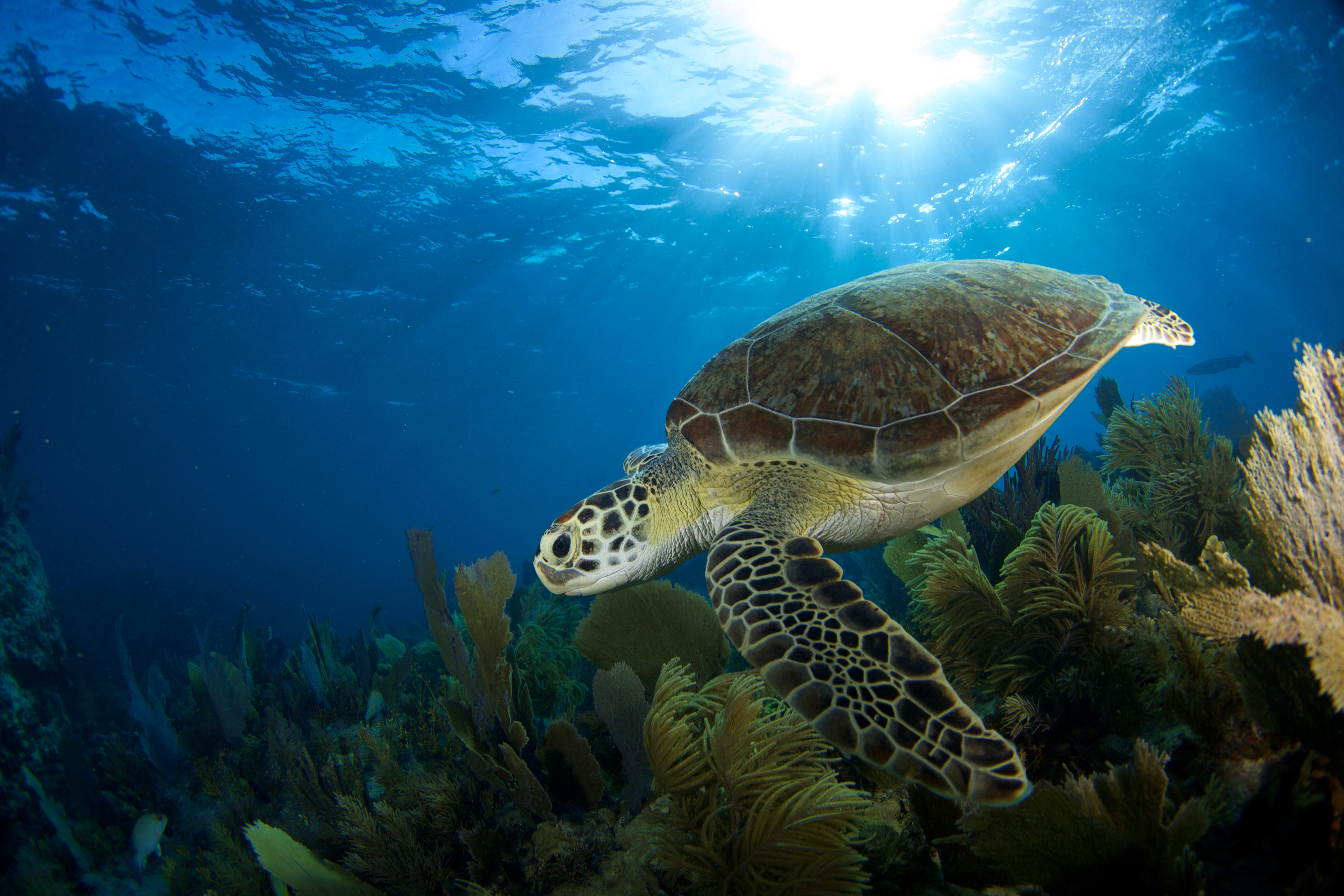
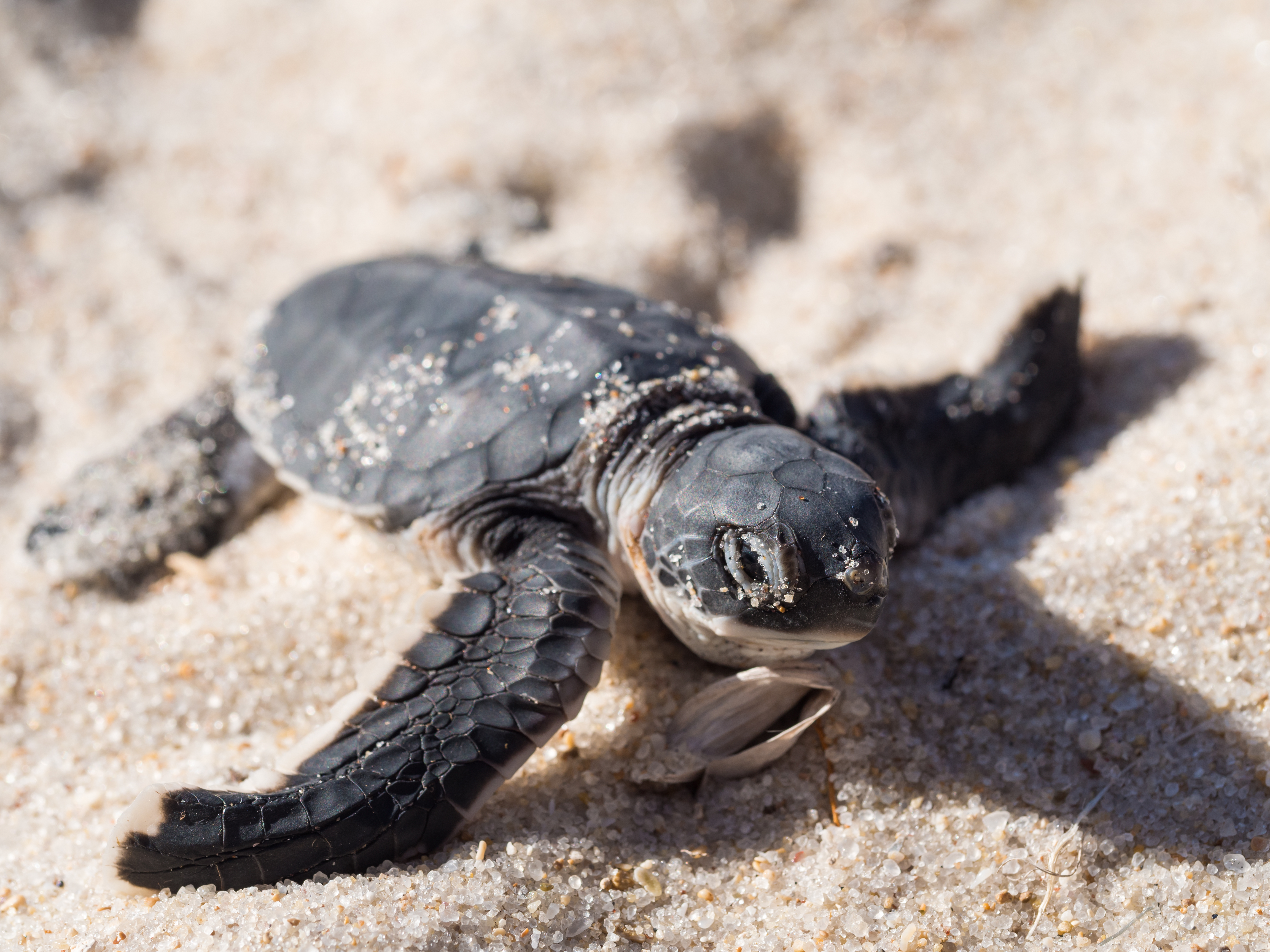
The Black Sea Turtle of the Pacific is often classified as the same as or sub-species of the Green Sea Turtle of the Atlantic. While similarities include diet and DNA, differences can be found in their physical appearance. The Black Sea Turtle has a body that is strongly elevated or vaulted and looks less round in a frontal view than other Green Sea Turtles. Black Sea Turtles tend to also be smaller than Greens and they generally lay fewer eggs. The colour is where you see the biggest difference with Black Sea Turtles having a dark grey to black carapace and dark grey-bluish-green plastron. Hatchlings of Greens and Blacks look the same with both being dark brown or black with a narrow white border and white underneath. Similar to Greens, Black Sea Turtles have a single pair of prefrontal scales (scales in front of its eyes), rather than two pairs as found on other sea turtles. Their head is small (smaller than Greens) and round with a serrated jaw. The carapace is bony without ridges and has large, non-overlapping, scutes present with only 4 lateral scutes. All flippers have 1 visible claw each.
Size
Adults measure up to 1 metre in carapace length.
Weight
Adults can weigh up to 100 kilograms.
Lifespan
Black Sea Turtles are estimated to live between 70 and 80 years or more.
Diet
The Black Sea Turtle’s diet is very similar to that of the Green Sea Turtle, and changes significantly during their life. When less than 20-25 centimetres in length, they eat worms, young crustaceans, aquatic insects, jellyfish, sea grass and algae. Once they reach 20-25 centimetres in length, they mostly eat sea grass, seaweed, algae, mangrove leaves and shoots, and other forms of marine plant life. The Green Sea Turtle (including the Black Sea Turtle) is the only sea turtle that is strictly herbivorous as an adult, giving their fat a green colour. Their jaws are finely serrated which aids them in tearing vegetation and scraping algae off hard surfaces.
Range
Black Sea Turtles are found in the temperate and tropical waters of the Pacific.
Habitat
Like the Green Sea Turtle, Black Sea Turtles mainly stay near the coastline and around islands and live in bays and protected shores, especially in areas with abundant algae and sea grass beds. Rarely are they observed in the open ocean. Juvenile Black Sea Turtles disperse into pelagic and neritic habitats along the continental shelf where they feed on a wider diet including invertebrates before returning to coastal waters and adopting a mostly herbivorous diet as adults.
Nesting
- Reproduction Interval: Every year
- Clutches Per Season: 1-3 clutches
- Clutch Size: 70-100 eggs
- Nest Incubation Period: 60 days
- Sexual Maturity: 15 years
Black Sea Turtles are the only sea turtles known to nest on the Galapagos Islands. Most of their nesting occurs in Central America, Mexico and the Galapagos.
Population Estimates
Between 5,000 and 10,000 individuals.
Status
International: Listed as Endangered (facing a very high risk of extinction in the wild in the near future) by the International Union for Conservation of Nature and Natural Resources in 1982.
USA: Downlisted to Threatened (likely to become endangered, in danger of extinction, within the foreseeable future) in April 2016 under the Federal US Endangered Species Act of 1973. Originally listed as Endangered in 1978.
(The Black Sea Turtles’ protection status is classified as the same as the Green Sea Turtle.)
Interesting Facts
- Current DNA research indicates a close genetic relationship between the Green and Black Sea Turtles, thus they are classified as the same species. However, due to their differences, some scientists consider the Black Sea Turtle to be a sub-species of the Green Sea Turtle while other scientists consider the Balck Sea Turtle to be its own species.
- Black Sea Turtles are the only sea turtles known to nest on the Galapagos Islands.
- Black Sea Turtles are more threatened than Green Sea Turtles as a result of the illegal harvest of eggs and turtle meat in Central America. For this reason, many conservationists consider the Black Sea Turtle a separate species to the Green Sea Turtle, as this would gain additional protection status for the Black Sea Turtle.
- While many species of sea turtles thermoregulate by spending time in warmer waters in the shallows or at the surface, Black Sea Turtles have been found to haul out of the water and bask in the sun along the Hawaiian Islands.
- Unlike Greens, Black Sea Turtles leave asymmetrical or ‘zipper’ tracks when they crawl up onto the beach. These are created when the turtle moves one flipper forward at a time.
- The Green and Black sea turtles are the only sea turtle that is strictly herbivorous as an adult. Their jaws are finely serrated which aids them in tearing vegetation and scraping algae off hard surfaces.
- Green and Black seas turtles are believed to aid the health of sea grass beds and associated microhabitats by grazing the beds and taking the tops off leaf blades, while avoiding the roots; thus the sea grass will grow back faster and healthier. This also aids in the carbon uptake of sea grasses.
- Green and Black sea turtles were once highly sought after their body fat, a key ingredient in ‘green turtle soup’. Despite it becoming illegal to trade them in many parts of the world, Green and Black sea turtles and their eggs continue to be consumed.
- Green and Black sea turtles were once a source of food for European explorers to the New World and helped crews navigate around islands at night by the increased volume of their aggregated breathing.
References
Álvarez-Varas, R., Véliz, D., Vélez-Rubio, G. M., Fallabrino, A., Zárate, P., Heidemeyer, M., Godoy, D. A. & Benítez, H. A. Identifying Genetic Lineages Through Shape: An Example in a Cosmopolitan Marine Turtle Species Using Geometric Morphometrics. PLoS ONE 14(10) (2019). https://doi.org/10.1371/journal.pone.0223587
ECOMAR: Species
Karl, S. A. & Bowen, B. W. Evolutionary Significant Units versus Geopolitical Taxonomy: Molecular Systematics of an Endangered Sea Turtle (genus Chelonia). Conservation Biology 13(5), 990-999 (2001). https://doi.org/10.1046/j.1523-1739.1999.97352.x
Mexican Fish: Pacific Black Sea Turtle
Sea Turtle Camp: Black Sea Turtle – A Unique Marine Turtle
Sea Turtle Preservation Society: Pacific Green Turtles, or Black Turtles
See Turtles: The Return of the Black Turtle
Upwell: Green Sea Turtle
 Koru Honu